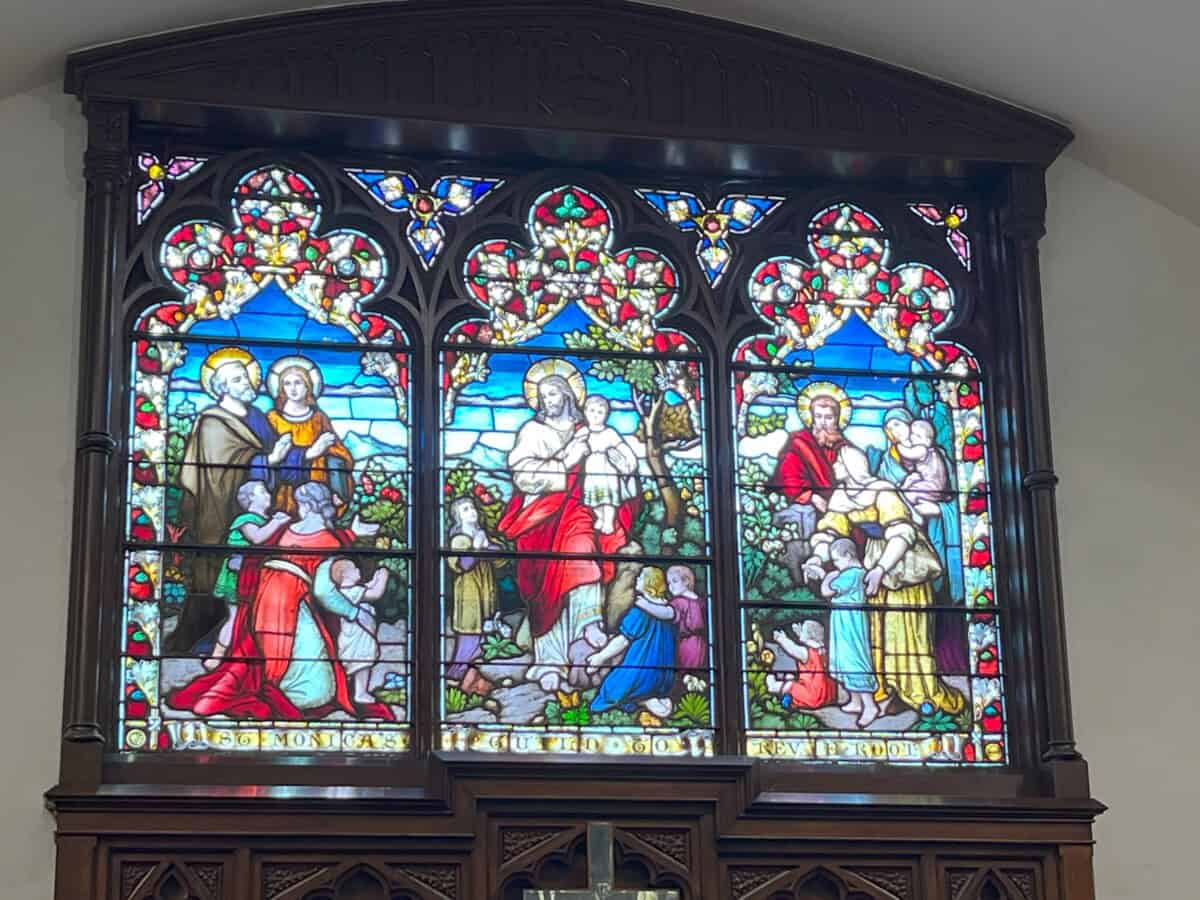
On our latest visit to St. Augustine, we stumbled upon the St. Augustine History Festival. During the 5-day event, the University of Florida Historic St. Augustine (UFHSA) presented special events at over 30 historic sites, churches, gardens, and cemeteries. Most events were free and didn’t require tickets or reservations.
I looked at the schedule and decided to see three sites – the Father Miguel O’Reilly House, Trinity Parish Church, and Memorial Presbyterian Church. It only took about two hours since the sites are located close to each other, and the tours occurred around the same time.
Father Miguel O’Reilly House
The Father Miguel O’Reilly House had been on my St. Augustine bucket list. However, I hadn’t been able to see it because the Sisters of St. Joseph closed the house museum during the pandemic and didn’t reopen it until February 2025.

The Spanish-style house is one of the oldest in St. Augustine. Although historians don’t know the exact date of construction, records show Father Miguel O’Reilly purchased it in 1785. After his death, the house served as a rectory for priests and a school. The first room displayed the hearth, original tile floors, and other artifacts such as a nun’s habit and a spinning wheel.
Most of the museum highlights the impact of the Sisters of St. Joseph. Eight nuns (ranging in age from 21 to 41) traveled to St. Augustine from Le Puy, France, at the invitation of Bishop Augustin Verot in 1866. Upon arrival, these women, who spoke little English, moved into the property and started teaching formerly enslaved Black children during the day and adults in the evenings. We walked through a room set up with benches and slate boards. In the corner sat a printing press, purchased by the sisters in 1889, as well as musical instruments, a typewriter, and old books. We then ventured upstairs to the tiny attic where the sisters slept.

I can’t imagine how homesick the nuns would have been. However, they stayed busy and started schools in other neighboring communities, including Mandarin, Palatka, and Fernandina. By 1886, they were teaching over 400 Florida students. The sisters still operate the school that started at the O’Reilly house, which is St. Joseph’s Academy (chartered 1876).
The sisters supported themselves by selling handmade lace and teaching music and French to the community. We entered a room set up with an altar, vestments, icons, and a monstrance. We then walked through a room with stained-glass windows, paintings, and other items created by the sisters.
Trinity Parish Church
This beautiful Episcopal church, the first Protestant church in Florida, sits at the intersection of King and St. George streets, across from the Plaza de la Constitución. Our docent led us to the sanctuary filled with tall stained glass windows and a buttressed wood ceiling.

Our guide explained that the congregation began under the leadership of Reverend Andrew Fowler in 1821 during the Yellow Fever epidemic. It’s important to note that when St. Augustine became part of the United States, no Protestant churches existed in the area. For about 20 years, St. Peter’s Anglican Church met during the British period. When the Spanish took over in 1783, they disbanded the church.
Under the leadership of Father Fowler, the congregation incorporated into a Parish and purchased the current property in 1823. By 1830, the building was completed. In the late 1890s, the Parish outgrew its space. After an “L-shaped” renovation in the 1890s, the church underwent a significant renovation at the turn of the century.
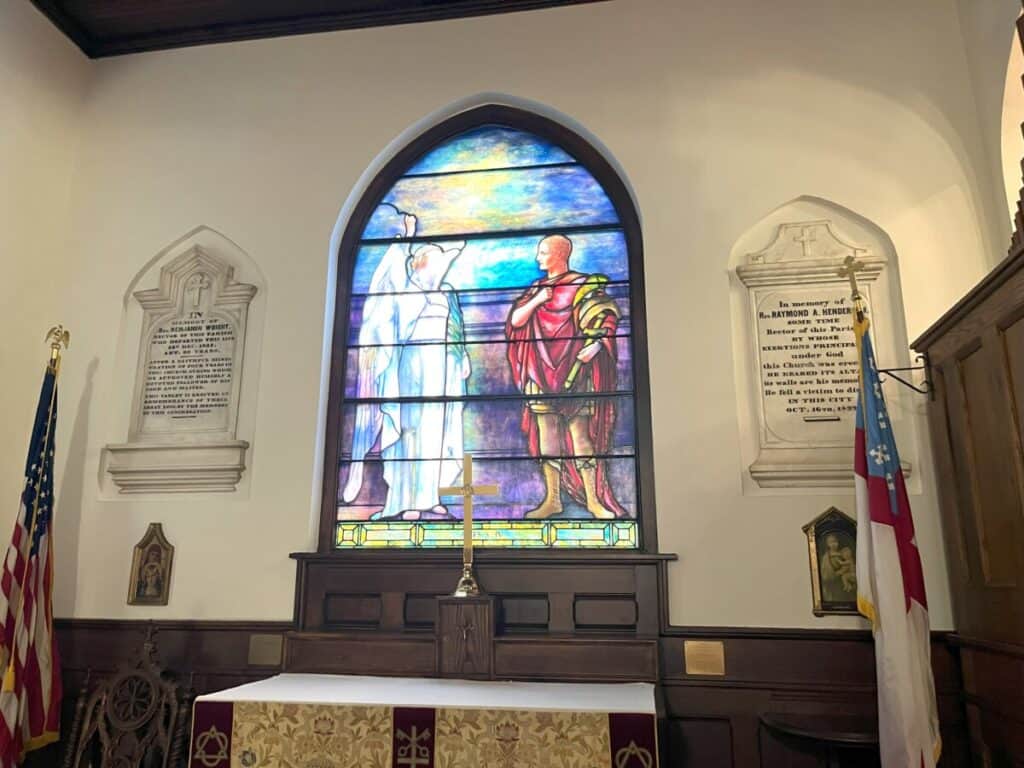
Finished in 1903, the Gothic-revival sanctuary boasted space for 300 people and today features 28 stained glass windows given as memorials to the church. The most famous is “Cornelius and the Angel,” created by Louis Comfort Tiffany (as in The Tiffany Window) and given to the church in 1905 by J.H. Hewson. The stained-glass windows above the altar are featured in the cover picture of this post.
Trinity Memorial Presbyterian Church
Next on our list was Trinity Memorial Presbyterian, just a block from Flagler College. The successes of Henry M. Flagler (1830-1913) are numerous. He became wealthy through his partnership with J.D. Rockefeller and the founding of Standard Oil. Later, he developed the Florida East Coast Railway, which stretched from Jacksonville to Key West, and built numerous Gilded Age hotels, including the Hotel Ponce de Leon (now Flagler College). Hotel Alcazar (now The Lightner Museum), and the Breakers.

Despite these achievements, Flagler suffered personal losses, including the death of his younger daughter Carrie and his first wife Mary. After the 1889 death of his surviving daughter, Jennie Louise Benedict, Flagler built a new sanctuary in her honor for First Presbyterian Church (incorporated 1824). Renamed Memorial Presbyterian Church, the church’s mausoleum houses the remains of Henry and Mary Flagler, daughter Jennie Louise, and granddaughter Marjorie.

Designed by architects Carrere & Hastings and influenced by St. Mark’s Basilica in Venice, the sanctuary features a Latin cross floor plan, mahogany pews, and a 150-foot-tall dome. A 700-pound cross sits on top, marking the highest part of the city.
When we entered the cavernous sanctuary, we felt tiny. We walked on the mosaic marble floor to the front, where a church member answered questions. The original pipe organ case graces the area above the chancel choir and pulpit. The original Roosevelt organ was at one time the largest in the state. It was replaced in 1970 by an Aolian-Skinner organ, which sits behind the screen.

While there are 92 stained-glass windows in the church, it wasn’t the first thing that caught my eye. Instead, the inner dome flanked by Matthew, Mark, Luke, and John, the bronze double-cross chandeliers, the tall torch lights at the end of select pews, and blue ceilings took my breath away.
I finally looked at the stained glass windows. Unlike the windows at Trinity Parish, which featured a picture of a Biblical story, these windows were much narrower and rested higher above the ground. They included the Apostles’ Creed text, a religious symbol, and a plant. The 92 stained-glass windows were added to the church in 1902.
Conclusion
For more information about Father Miguel O’Reilly House, click the website here. The Sisters of St. Joseph have reopened the museum and gardens from Tuesdays to Saturdays. There is no cost for admission, but donations are appreciated.
It’s one thing to see the outside of a church, but quite another to actually go inside it. I highly recommend seeing these beautiful historic St. Augustine churches. Trinity Parish typically offers tours on Thursdays and Fridays. Tours for Memorial Presbyterian occur on Fridays and Sundays. Check the websites in case of cancellations due to funerals, weddings, or special programs.
Pingback: St. Augustine Travel Guide • Finding Family Adventures