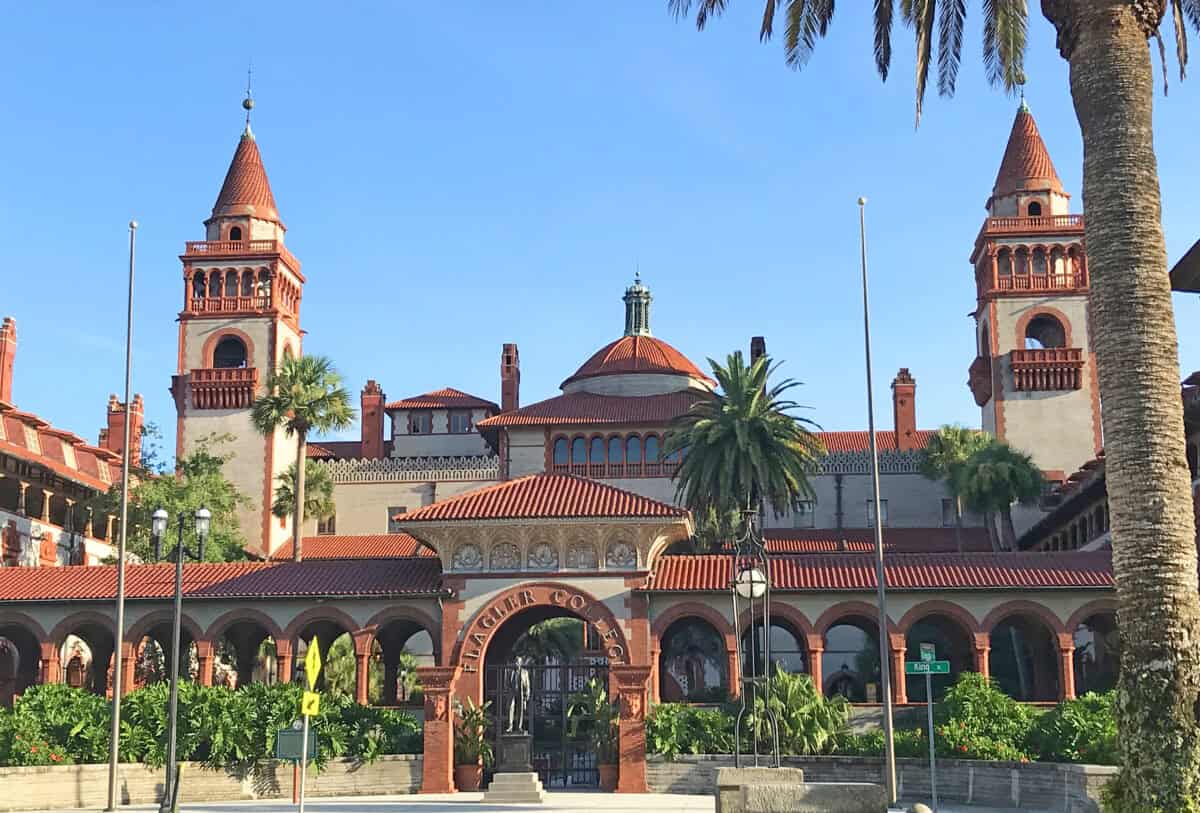
It’s a busy season around here. Within the past year, we’ve had two college graduations and one wedding! Today’s post highlights Flagler College in St. Augustine, Florida, where Thing 1 graduated.
Everyone asks, “How did your daughter pick Flagler?” Well, it’s easy. Flagler was one of the few colleges open for college tours in August 2020 during the pandemic. I knew someone who attended there in the late 1980s and had seen the campus in the early 1990s. I remember Flagler being a small, liberal arts college in a pretty cool town. Despite not being able to enter many of the campus buildings during the tour, Flagler College felt like the right choice for my daughter. And we fell in love with St. Augustine.
Henry Flagler
You can’t discuss St. Augustine’s history without mentioning Henry Flagler (1830-1913). The railroad magnate put Florida on the map when he invested heavily in the state’s railroad and hotel industries.

Flagler, one of the founders of Standard Oil Company, first visited St. Augustine with his second wife in 1883. He immediately saw potential in the relatively undeveloped state and soon purchased the Jacksonville, St. Augustine, & Halifax Railroad, as well as land to build the Hotel Ponce de Leon. After all, if you build hotels, you have to have a way to get guests there.
Over the following decades, Flagler added hotels and railroads to his portfolio. He built the Hotel Royal Poinciana and the Breakers in Palm Beach, as well as the Hotel Continental in Atlantic Beach. By 1896, his Florida East Coast Railway (FEC), connected Jacksonville to Miami. Some historians suggest that residents of Miami wanted to name their new town after him, but he turned them down.

The most ambitious project for Flager was to complete the Over-Sea Railroad extending all the way to Key West. Completed in 1912, Flagler realized his dream before his death the following year. The railroad operated successfully until it was destroyed by the Hurricane of 1935. At that time, the state of Florida didn’t rebuild the railroad, but used the infrastructure to create the Overseas Highway (Hwy 1), connecting the Keys to the mainland.
Hotel Ponce de Leon History
Flager hired the firm of Carrere & Hastings (later known for building the New York Public Library) to design a Spanish Renaissance Revival-style hotel in the late 1880s. Sparing no expense, Flagler hired Thomas Edison to install the electricity and Louis Comfort Tiffany to design stained-glass windows in the oval-shaped dining room. The two hotel towers each held 8,000 gallons of water to provide running water.

When Hotel Ponce opened in 1888, guests walked through the courtyard, past the fountain and entered through the arched oak doors. They would have stood in awe at the three-story rotunda with gilded ceiling and murals painted by George Maynard. Featuring 450 hotel rooms, the hotel welcomed guests such as John Jacob Astor and President Grover Cleveland. You definitely had to be wealthy to enjoy the hotel – the cost was $4,000 for the season lasting only from Christmas to Easter.
Directly across the Rotunda, guests would walk up the half-staircase to enter the grandiose dining room. With 48-foot-tall barrel vaulted ceilings and 14,000 square feet, the dining room easily served 300 guests. Reminiscent of Hogwarts Great Hall, Flagler College hosts Harry Potter Week annually.

Shortly afterward, Flager built the Hotel Alcazar (now Lightner Museum) across the street. In addition to being a hotel, it housed many of the amenities for Hotel Ponce guests such as the Turkish baths, indoor swimming pool (the first in Florida), casino, and ballroom. Later Flagler aquired the Cordova Hotel (now Casa Monica) next to Hotel Alcazar. He considered it an overflow for the Hotel Alcazar and connected the two buildings by a second-floor bridge in 1902.

Decline of Hotel Ponce
Unfortunately, as Flagler moved his railroad further south and built more hotels, tourists followed. The Cordova closed in 1932, while both the Alcazar and Ponce were used for the Coast Guard during WWII. Although the Hotel Ponce reopened after the war, it never regained its original prestige and closed for good in 1967. During its 79-year history, Presidents Teddy Roosevelt, Franklin Roosevelt, John Kennedy, Grover Cleveland, Lyndon Johnson, and Warren Harding stayed at the hotel.
Flagler College History
Lawrence Lewis, grandnephew of Henry Flagler, donated the Hotel Ponce to a group wanting to start a female college in 1968. The fledgling college almost failed, but in 1971 Lewis stepped in to reorganize it, set up the Board of Trustees (he served as Chairman for 20 years), and made it co-ed. The college earned accreditation in 1973 and currently boasts 2,400 students and over three dozen majors.

Lewis and his sister, Mary “Molly” Lily Flagler Lewis Wiley, contributed millions of dollars to help the campus. Lewis House (dormitory) and Lewis Auditorium are named after Lewis. Wiley donated Casa Amarylla, her mother’s house, to the college in 1975. Built in 1898, the home sat next to the Hotel Ponce as it originally housed the hotel’s doctor and his family. Thing 1 even had a few classes in Wiley Hall.

Had it not been for Lewis and Wiley’s philanthropic gifts and ongoing support through the Flagler Foundation, the college may not have survived. For 2024-2025, US World & National Report ranks Flagler #3 in Regional Colleges South and #14 in Best Value Schools.

Flagler College’s success is also attributable to its strong leadership. Dr. William Proctor served as the first president of the college for 30 years, followed by almost another 20 years as Chancellor. Dr. William T. Abare, who had been a Flagler College administrator since 1971, served as the second president until 2017.
Dorm-Life at Flagler
Thing 1 lived on campus all four years. The first year, she lived in Ponce – the iconic building of Flagler College and former Hotel Ponce built by Flagler. While in the center of campus and connected to the dining hall, Ponce didn’t feel much like a typical dorm. Tours occurred regularly in the lobby and security to enter the building was tight. (Usually, adults hanging around a dorm are parents, but in this instance, adults could be random tourists from all over the world.) The dorm was huge with two wings with long corridors and wide halls. Each room had a different floor plan, so dorm layouts varied from four-person rooms with a fireplace to a single room with a dormer window. Right after Thing 1’s freshman year, the college closed parts of the dorm for extensive renovations that are soon to be completed.


Most sophomores live in Abare Hall. This dorm shared a lobby and amenities with FEC Dorm (the renovated Flagler’s Florida East Coast Railway Building) and sat along the San Sebastian River. Although a bit of a walk from the central part of campus, the dorm is adjacent to the Malaga Street Parking Deck. Abare offered more of a dorm experience with a central lobby area, a Pod Market for convenience foods and supplies, and an exercise room. The dorm suites included a single room, a double room, a bathroom, and a small kitchenette area.


Sebastian House is a brand-new dorm reserved for juniors and seniors. The college purchased the former Sebastian Hotel from Radisson. Located about a ten-minute walk to the main campus, most of the dorm rooms offered two queen-size beds, a built-in kitchenette, a small couch, and flat-screen TVs. A large patio deck, swimming pool, and parking lot sat outside. The amenities outweighed the distance to campus in my daughter’s opinion!
Graduation
Four years flew by, and Thing 1 graduated. The college hosted a large reception for parents, and we got to see inside the Alumni House and Markland, the home of the Flagler College President. Louis the Lion (the school mascot) was on hand to greet guests.

Since graduates, parents, and friends need a large space, Flagler’s graduation is held at the St. Augustine Amphitheatre, located on Anastasia Island. There was a threat of rain for a while, and all of us parents feared a cancellation of graduation. Fortunately, it went off without a hitch and Thing 1 proudly received her diploma in Public History from President John A. Delaney.
Conclusion
For information about Flagler College, check out its website here. You can also see pictures of Flagler College through the years, from this 2019 article by The Florida Times-Union.

Pingback: St. Augustine Travel Guide • Finding Family Adventures
Pingback: St. Augustine Pirate & Treasure Museum - St. Augustine, FL • Finding Family Adventures
Pingback: Ocmulgee Mounds National Historic Park - Macon, GA • Finding Family Adventures