Spring is always a fun time to visit St. Augustine. We loved going down there every year for the tail end of our daughter’s spring break at Flagler College. Even though she usually came home for the week, we found excuses to make the trip down there since she had a few days off from school to be a tourist. Last spring, we decided to go to Marineland.
Marineland isn’t a place you hear about much now. But in its heyday from the 1940s to 1970s, Marineland drew in crowds of up to 500,000 per year. When my parents took me to Disney World when I was four, we made a stop at Marineland. I don’t remember that part of the trip, so I wanted to make a return visit.
Marineland
Located less than 20 miles from St. Augustine, Marineland opened its doors in 1938 to much fanfare. For the first time in history, scientists and the general public could observe marine life swimming together. Before that, people only observed marine life in aquariums where they were separated by species and inhabited in much smaller tanks.
Marineland History
Four wealthy New Yorkers, Sherman Pratt, Ilya Tolstoy, W. Douglas Burden, and Cornelius “Sonny” Vanderbilt Whitney, wanted to establish a film studio to capture marine life. At the time, filming animals was a popular technique for studying their behavior. However, since underwater cameras had yet to be invented, the only way to film marine life was to build huge tanks that mimicked the ocean.
Marine Studios, later renamed Marineland in 1961, was built on 125 acres off Highway A1A and featured two large tanks of over 450,000 gallons of water each. Large pipes pumped water in from the Atlantic to maintain an oceanic environment for the inhabitants. Visitors viewed the sea creatures through over 200 square portholes resembling a TV screen and watched marine animal feedings.

Despite the Depression, tourists came in droves to visit Marineland. Later, Marineland Motel, Dolphin Restaurant, Moby Dick Lounge (which rocked like a ship), and Sandpiper Snack Bar popped up to accommodate tourists. Marineland soon became a town in its own right. By the 1970s, the park added a 3-D theatre experience and boasted sharks, eels, sea lions, and of course, Nellie the dolphin, who lived her entire 61 years at Marineland.
Significant strides in dolphin research also continued. “Spray” became the first dolphin born in captivity in 1947, and in 1949, “Flippy the Educated Porpoise” made his debut in the first marine show. In 1974, the University of Florida opened the Whitney Laboratory for Marine Bioscience on the property. While educational filming remained prevalent, Hollywood took notice in the 1950s and used the site for “The Creature from the Black Lagoon,” “Revenge of the Creature,” and others.

Unfortunately, tourism declined in the 1980s due to the emergence of Sea World and other theme parks. In 1983, Whitney sold the park to a group that made so many changes, the property lost money and went into bankruptcy. Marineland caught the attention of real-estate developer Jim Jacoby. He purchased the property, which had suffered years of neglect and significant hurricane damage, and reopened it in 2006 as Marineland Dolphin Conservation Center with a focus on education. However, most buildings, including the original tanks, were demolished because of structural problems.
Marineland Exhibits Today
Instead of offering dolphin shows from its past, Marineland hosts educational programs and focuses on areas of conservation and animal husbandry. Today, the facility (renamed Marineland Dolphin Adventure in 2011) hosts 13 dolphins, over 300 fish, a tortoise exhibit, and reptiles.

We explored the area south of the main entrance first. Rocky the Loggerhead turtle was a bit hard to find as we peered into the windows. Finally, he showed up. At over 25 years old, he weighs about 200 pounds. Rocky is a rescue from a severe boating accident. Although mostly recovered, he is blind in one eye so he will probably not be released into the ocean.
A circular tank is home to four sand tiger sharks. We stepped up to hear the tail-end of a talk by one of the employees and learned the exhibit aims to promote breeding by providing both an indoor and outdoor environment. Why is breeding important? Due to illegal shark finning, sand tiger sharks are at risk of extinction.

An interactive exhibit allowed us to try out different sailor knots while learning about sea turtles. Parents can download activity sheets for kids to identify certain marine animals.
Marineland Sea to Shore (Behind the Scenes) Tour
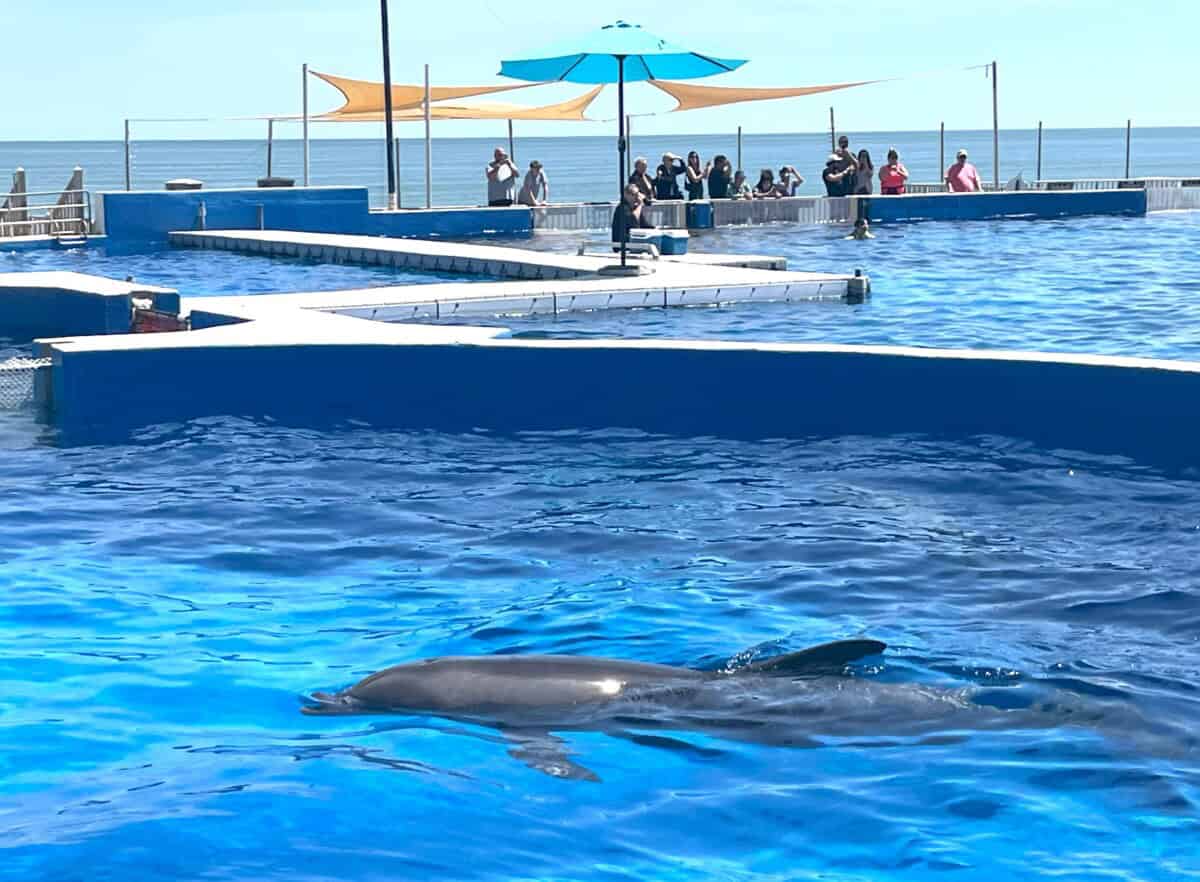
We then headed to the dolphin area on the other side of the gift shop. The large windows allowed us to see the dolphins swimming under the water. A raised platform gave us a higher view where we could watch the dolphins above the water.

The general admission tickets include the Sea to Shore Tour. I’m so glad we stayed for this because it opened up more exhibits for us to see. The tour guide led us into the dolphin area, where people were interacting with dolphins. These tanks, built in 2006, were designed to allow people to get in the water to interact with dolphins. Programs for an additional fee include Swimming with Dolphins, Trainer for a Day, and a Meet and Greet for those not wanting to get into the water.

From here, we went inside a large building and down a flight of stairs to an aquarium full of fish, invertebrates, and terrapins. A greenish Moray Eel peered out from a tank. Other exhibits included an octopus, lion fish, and a window to get a different view of the dolphins.


As we left the aquarium, we walked past the dolphins swimming, jumping, and playing. It was mesmerizing to watch!
Conclusion
Marineland is a great spot to visit if you want to interact with dolphins. If you’re only purchasing general admission tickets, make sure to stay for the complimentary Sea to Shore Tour. Just remember, Marineland today is not the same as Marineland of the 1960s and 1970s. You won’t find dolphin shows and you’ll have to drive a few miles to find a restaurant. But you won’t have to battle crowds either. Other than that, I recommend visiting only after you’ve seen everything else in St. Augustine.
For more information about Marineland Dolphin Adventures, click here. A great resource about Marineland at its peak is Diving Into Marineland, by Flagler College. My daughter participated in this archival project when she was a student.
Pingback: St. Augustine Travel Guide • Finding Family Adventures