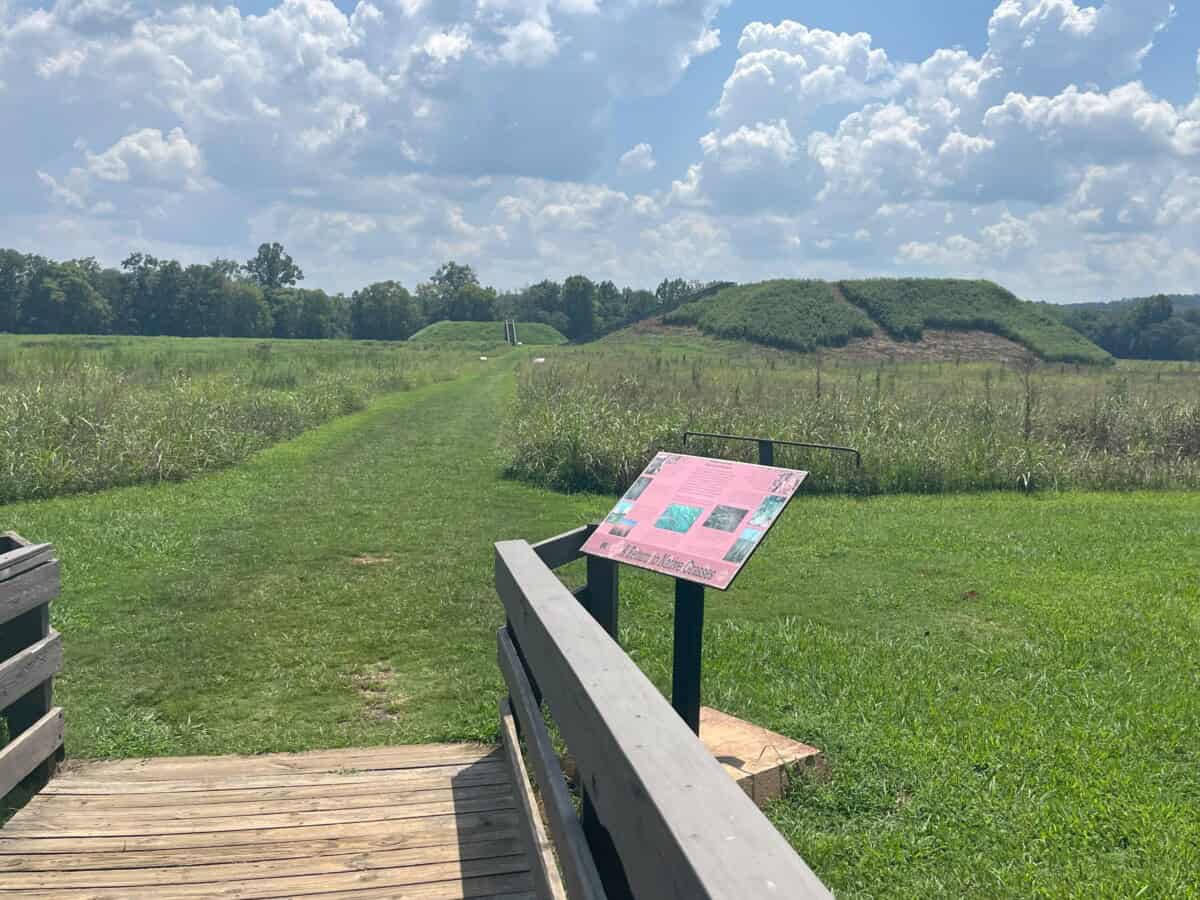
Thing 1 moved back home after graduating from college with a degree in public history so we’ve been exploring some of the historical museums and state parks near Atlanta lately. Our latest jaunt took us to the Etowah Indian Mounds State Historic Site in Cartersville.
Georgia’s Museum City, Cartersville
Located only 45 miles northwest of Atlanta, Cartersville has become a magnet for top-quality museums. The city boasts the Booth Western Art Museum, Tellus Science Museum, and the Savoy Auto Museum, earning the nickname “Georgia’s Museum City.” These museums are all worthy of a visit. But if you’re looking for something older – like from 1,000 years ago – head to Etowah Indian Mounds, also in Cartersville.
Etowah Indian Mounds
Opened by the state in 1953, Etowah is one of the best-preserved sites of Indian mounds in the Southeast. Although the Creek Indians lived in the area during our nation’s early history, they were not the first. The Mississippians, an ancient native people who lived around 900 to 1550 AD, settled here first and built these earthen mounds along the Etowah River. In fact, Mound A at 63 feet is the tallest, not only at the 54-acre site, but also in Georgia.
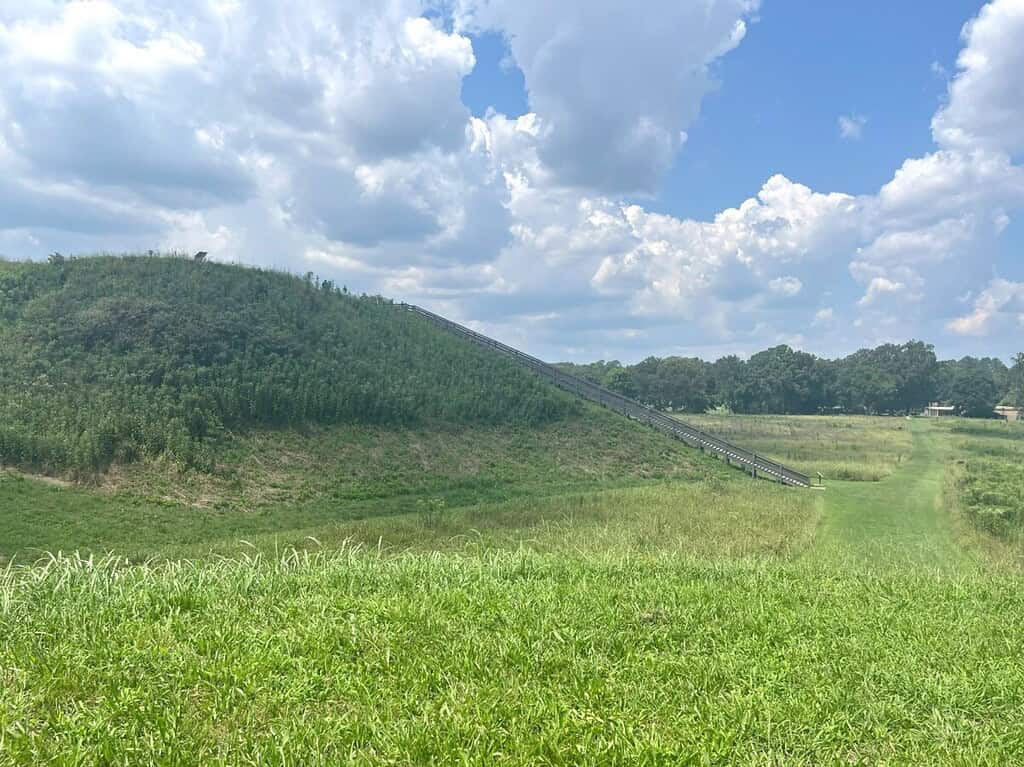
The Mississippians built the earthen mounds by hand. They didn’t have the luxury of bobcats, or even wheelbarrows for that matter. Tribe members collected dirt from areas, known as borrow pits, in baskets and emptied them at the designated mounds (six in the case of Etowah). Each basket of dirt weighed about 60 pounds, so it’s no wonder this process took about 300 years. Over time, the borrow pits were 9-10 feet deep.
Mississippians Time Periods and the Layout of Etowah
Researchers divide the Mississippian period into three distinct stages: Early from 900-1200, Middle from 1,200-1,350, and Late from 1,350 to 1,550. Archaeologists believe Etowah, which began as a village, rose to prominence as a capital city during the Middle Mississippian Period. The chief lived here at Etowah, most likely on top of Mound A, providing an active center for as many as 1,000 residents from smaller villages in the region.

We climbed to the top of Mound A via a set of stairs. From the top, we had a great view of Mounds B and C, the Plaza, and a glimpse of the Etowah River. In the distance, we could barely see Mounds D, E, and F because they were so small. Built during the Late Mississippian period, these mounds most likely became the platform for houses of prominent village citizens. We then climbed to the top of Mound B, which is 25 feet high.
The Villagers may have used Mound B as a temple or home for a priest, while they used Mound C for burials. It is important to note that the different layers in the mounds suggest that they may have served different purposes at different times. For example, archaeologists discovered the remains of what would have been a circular building, possibly used for higher social ranking ceremonies, on Mound B. They also discovered remains of a rectangular structure and terrace built after the destruction of the circular building.
At just 10 feet tall, Mound C contained burials as found by major excavations in the 20th and 21st centuries. Many of the items housed in the museum before 2023 (more about that later) came from those excavations.
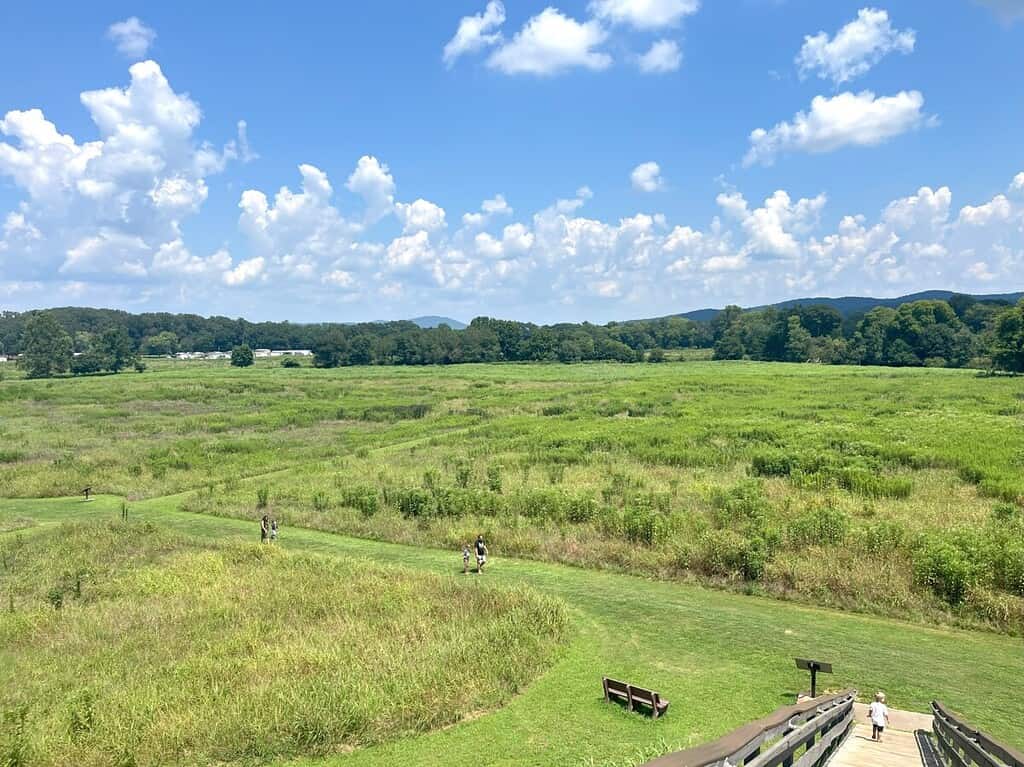
The Plaza stretched out eastward from Mound A and was likely the center of village life. Here, the villagers would gather, host ceremonies, play games, and trade with others. I found it interesting that the Indians hosted multi-day skill games and competitions, much like the Olympics, on the Plaza.
We also learned that the Mississippians grew crops known as the “three sisters” of corn, beans, and squash. Unlike Ocmulgee Mounds National Historic Park in Macon, with neatly mowed grass on the mounds, Etowah allows native grasses and plants to cover the landscape.
Wattle and Daub Hut
Wattle and daub huts would have surrounded the Plaza. In 2008, volunteers recreated a hut near the museum. They built it with woven wood sticks and branches, “wattle”, and then applied a mixture of red Georgia clay (at least it’s good for something), grass, and water as the glue or “daub” to hold it together.
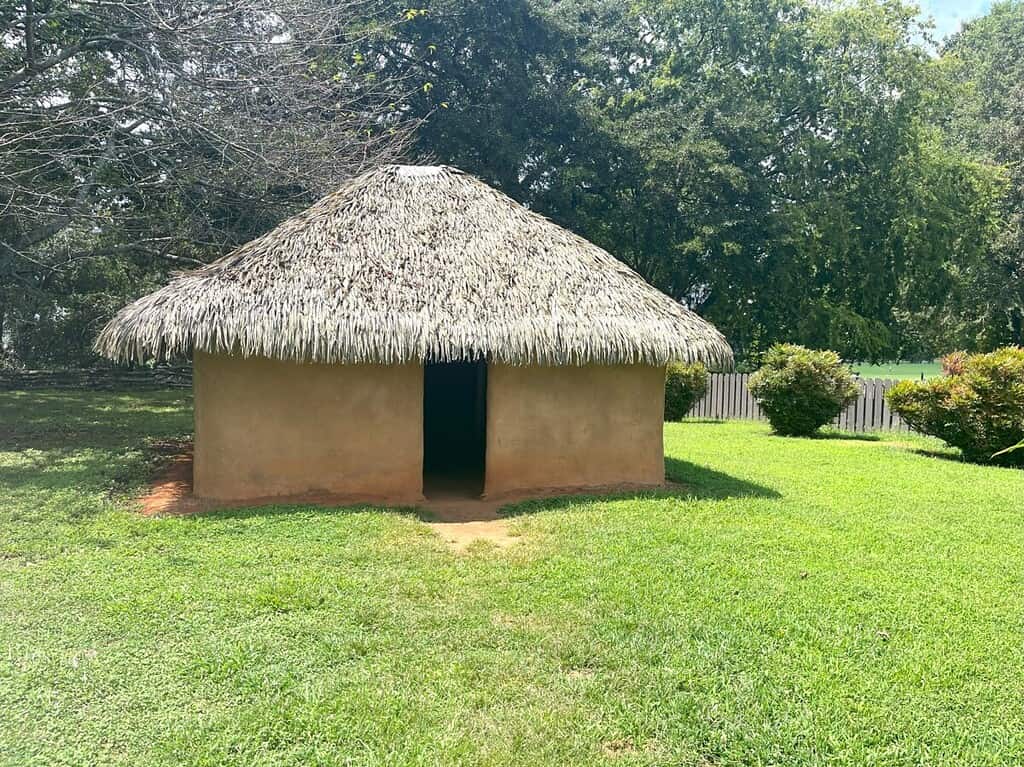
Inside the structure, we saw benches surrounding the circular walls and a fire pit in the middle. Native Indians used the benches for sleeping and the firepits for warmth and cooking. Directly above the fire pit, a round opening provided an exit for the rising smoke from the flames.
Etowah Archaeological Museum
While on the grounds and inside the museum, we learned more about the Mississippians. I always thought of Indians as having small independent tribes with no central government. In reality, this wasn’t the case. Similar to modern government, the Mississippians created chiefdoms and Etowah served as a capital city for one. However, by the Late Mississippian period, Etowah was simply one of a handful of villages within the Coosa Chiefdom.

Sometime after the Mississippian period, the Muscogee Creek Indians settled the land until the 1830s, when the US government forced their removal during the Trail of Tears. The name Etowah comes from the Creek word “Italwah,” meaning trail crossing.
In 1832, Colonel Lewis Tumlin drew the lot in the Land Lottery. His family authorized excavations of Mound C in the 1880s and 1920s. They later sold the property to the state, which in turn, opened the park. The state also conducted excavations in the 1950s, 1970s, and 2000s.

We spent some time in the museum and watched a 15-minute film before leaving. The museum was a bit underwhelming. In response to the Native American Graves Protection & Repatriation Act (NAGPRA), Etowah has returned many artifacts, including two famous Georgia marble effigy statues, to the Muscogee Creek Nation. The newly opened museum focuses more on educating the public about the Mississippian people and their culture, instead of displaying artifacts.
In Conclusion
Etowah Indian Mounds offers a historical glimpse into the lives of early Native Americans, taking about an hour to visit. Admission is $6 for adults, $4 for kids ages 6-17, and $4.50 for seniors. For more information, visit the park’s website here. You should also check out Ocmulgee Mounds National Historic Site in Macon, at the website here.