For Christmas this year, we flew into San Antonio and stayed overnight before heading to the Texas Hill Country to meet up with the rest of the family. It had been 13 years since we’d been there, and let me tell you, San Antonio is much more enjoyable when it’s not 110 degrees like it was that summer! Instead of temps above 100 degrees, it was only 79 degrees on Christmas Day.
I’m always amazed by San Antonio’s size. It’s the second-largest city in Texas, with 1.5 million people, and the 7th-largest city in the US. But it doesn’t feel that large. It also has a long history, dating back to the founding of the San Antonio de Valero mission and San Antonio de Bexar Presidio in 1718.
San Antonio Riverwalk
The top tourist spot in San Antonio is the Riverwalk, also called Paseo del Rio. Although the 15-mile Riverwalk extends from Brackenridge Park to Mission Espada, the most popular section is the Downtown Loop. This 2.5-mile horseshoe-shaped section meanders past sidewalk cafes, shops, and hotels. Scenic bridges and staircases connect visitors to nearby historical sites such as the Alamo, San Fernando Cathedral, the Bexar County Courthouse, and more.
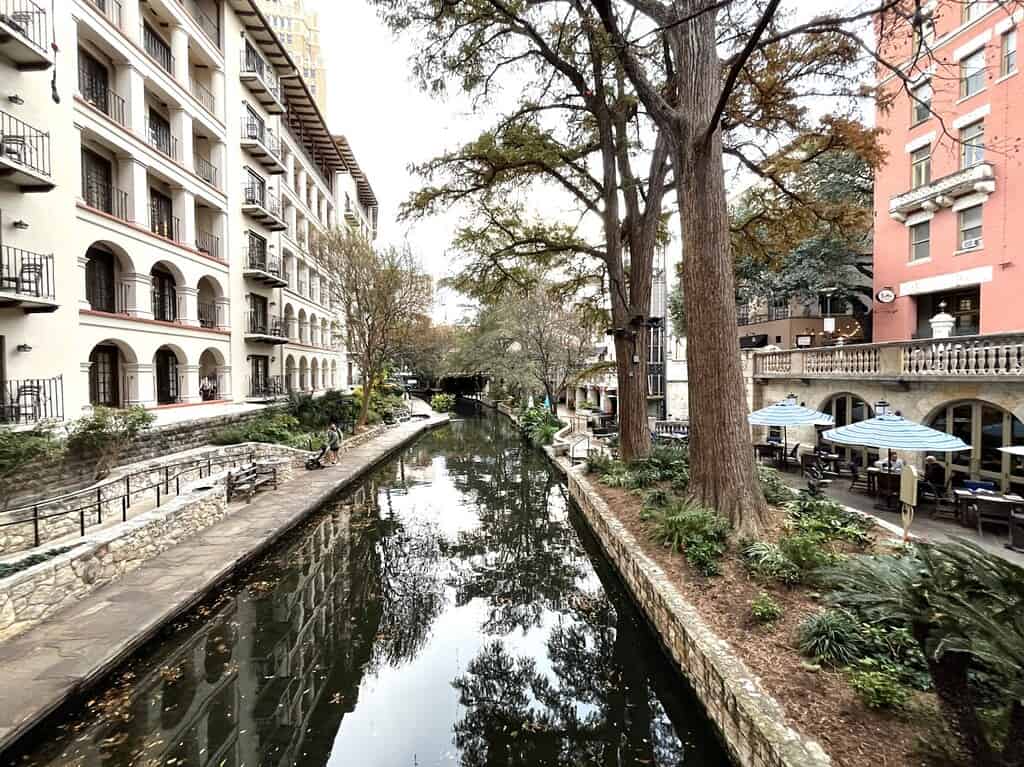
However, the Downtown Riverwalk as we know it today wouldn’t be here except for the efforts of Robert H. H. Hugman (1902-1980). To reduce the effects of multiple downtown floods (including the deadly 1921 flood), engineers cut a channel across the horseshoe, or “Great Bend,” of the San Antonio River, added a dam, and built floodgates. City leaders wanted to pave over the old bend with concrete, but in 1929, Hugman proposed a linear park resembling Venice with bridges, landscaping, and gondolas.
It wasn’t until 1941 that the downtown Riverwalk was completed. However, businesses were slow to capitalize on the riverfront property. Casa Rio, a Mexican restaurant still in operation, opened in 1946, followed 15 years later by the El Tropicano Hotel in 1962. My father worked downtown in 1963 and said he’d often only see one or two people when he walked around on his lunch hour.

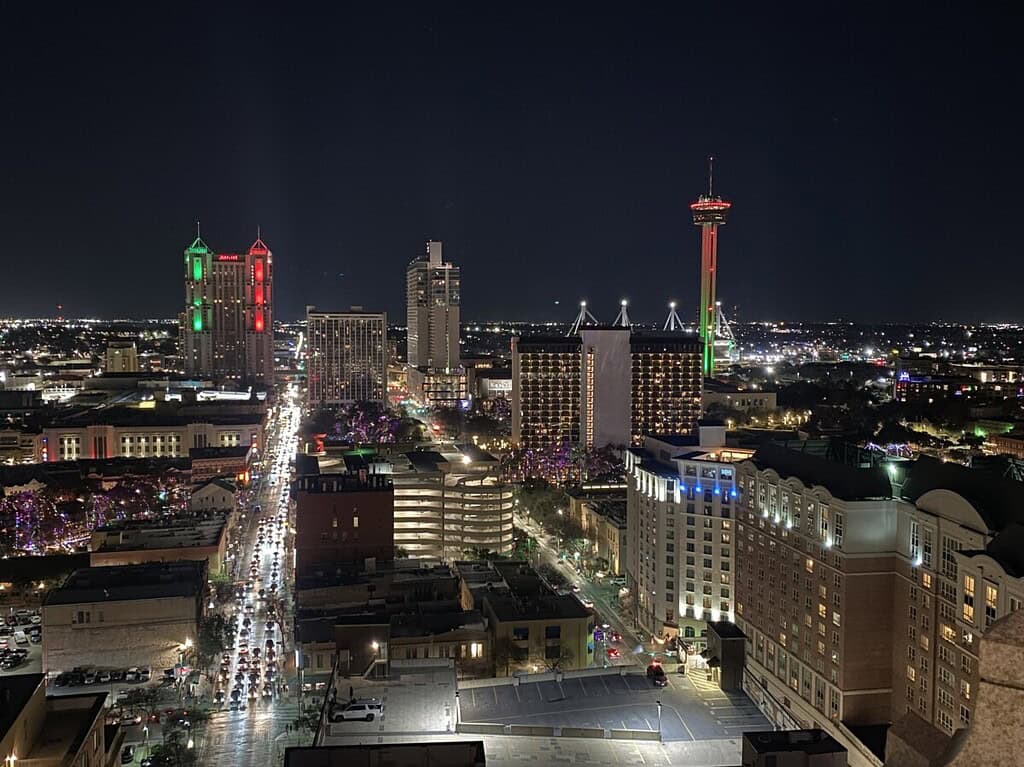
The Riverwalk didn’t really catch on until the 1968 World’s Fair. Held between April and October, HemisFair ’68 drew over 6 million visitors to downtown San Antonio, featuring expositions, the first modularly built Hilton Palacio del Rio (you can see historic pics and video here), and the 750-foot-tall Tower of the Americas – all connected by extensions in the River Walk. Today, San Antonio is a major convention destination due to all the restaurants and hotels situated along its crown jewel, the Downtown Riverwalk. While we didn’t have time to do this, Go Rio offers narrated tours on electric barges through the Riverwalk daily.
The Alamo
Alamo History
Did you know the Alamo was the first Spanish mission in San Antonio? Back in the 1700s, Spanish Franciscans established five missions along the San Antonio River to convert Native Americans to Catholicism. The first mission, Mission San Antonio de Valero, operated at its present location from 1724 to 1794. It only became known as the Alamo in 1803 when the Spanish sent soldiers from Alamo de Parras (Mexico) to establish a military fortress.

The Battle of the Alamo
Most people associate the Alamo with the Texas Revolution. In a nutshell, Mexico gained independence from Spain in 1821, but by 1835, Texas wanted independence from Mexico. Although the Texans put up a good fight against the Mexican Army during the 13-day siege at the Alamo, they lost the bloody battle after the deaths of Davy Crockett, Jim Bowie, William Travis, and approximately 200 other defenders. The slogan “Remember the Alamo” became the rallying cry during the subsequent Battle of San Jacinto, which led to Texas becoming its own republic on April 21, 1836.

Disrepair and Decline
When Texas became part of the United States, the US Army occupied the Alamo on and off for the next 30 years. One of the biggest changes was the addition of the widely recognized scalloped parapet above the front doors in 1849. After the US Army left, the Catholic church rented the property to a grocer who used the chapel as a warehouse. Unfortunately, the Alamo fell into disrepair, and commercial development overtook the area. Many tourists are surprised that it is so small compared to its original 4 acres. Only the chapel and long barracks still stand today.
The state of Texas purchased the site in 1883 and, in 1905, gave it to the Daughters of the Republic of Texas (DRT) to manage. That in and of itself is its own story, and the partnership with the DRT ended in 2011. Today, the Alamo Trust manages the site for its owner, the Texas General Land Office. Restoration to the site includes $550 million from the state and private donors.

Restoration of the Alamo
An exhibit inside the Alamo’s chapel includes a diorama depicting the grounds as they looked in 1836. Above the nave, the six flags of Texas fly. Commemorative plaques line the walls, along with flags representing the states from which the defenders of the Alamo came. Conservation efforts are highlighted with information regarding changes the US Army made to the church.

The Long Barracks, which only reopened in 2021 after an archaeological study, hosts a small museum and a video depicting the Battle of the Alamo. A new exhibit, “Surrounded: The Alamo Augmented Experience,” occupies most of the building and costs $10.
Behind the church building is the new, 24,000-square-foot Ralston Family Collection Center, which houses numerous artifacts from the Alamo. A large portion of the collection came from Phil Collins (yes – that Phil Collins, the British musician). You can read all about Collins’ interest in the Alamo from the June 2014 Texas Monthly article here. In 2027, the Alamo Trust plans to build a large visitor center and museum that incorporates the historic Woolworth and Crockett buildings. These buildings on the Crockett block were erected in the 1870s, where the Alamo’s west wall once stood.
Other Downton San Antonio Attractions
Our hotel, located on the Riverwalk, was just a few blocks from the Bexar (pronounced “bear”) County Courthouse. We walked over to the four-story Romanesque Revival building made from Texas granite and red sandstone. Built in 1896 by James Riley Gordon, it wasn’t the county’s first courthouse, but the fifth. Today, according to the Bexar County Historic Commission, it is “the largest and oldest continually operating historic courthouse in Texas.”

Closed for the holidays, we couldn’t go inside. Instead, we walked around the massive structure and marveled at its size. In front, the Founders Monument features five figures representative of San Antonio’s history: a Native American, a Catholic priest, a soldier from the presidio, and a couple from the Canary Islands.
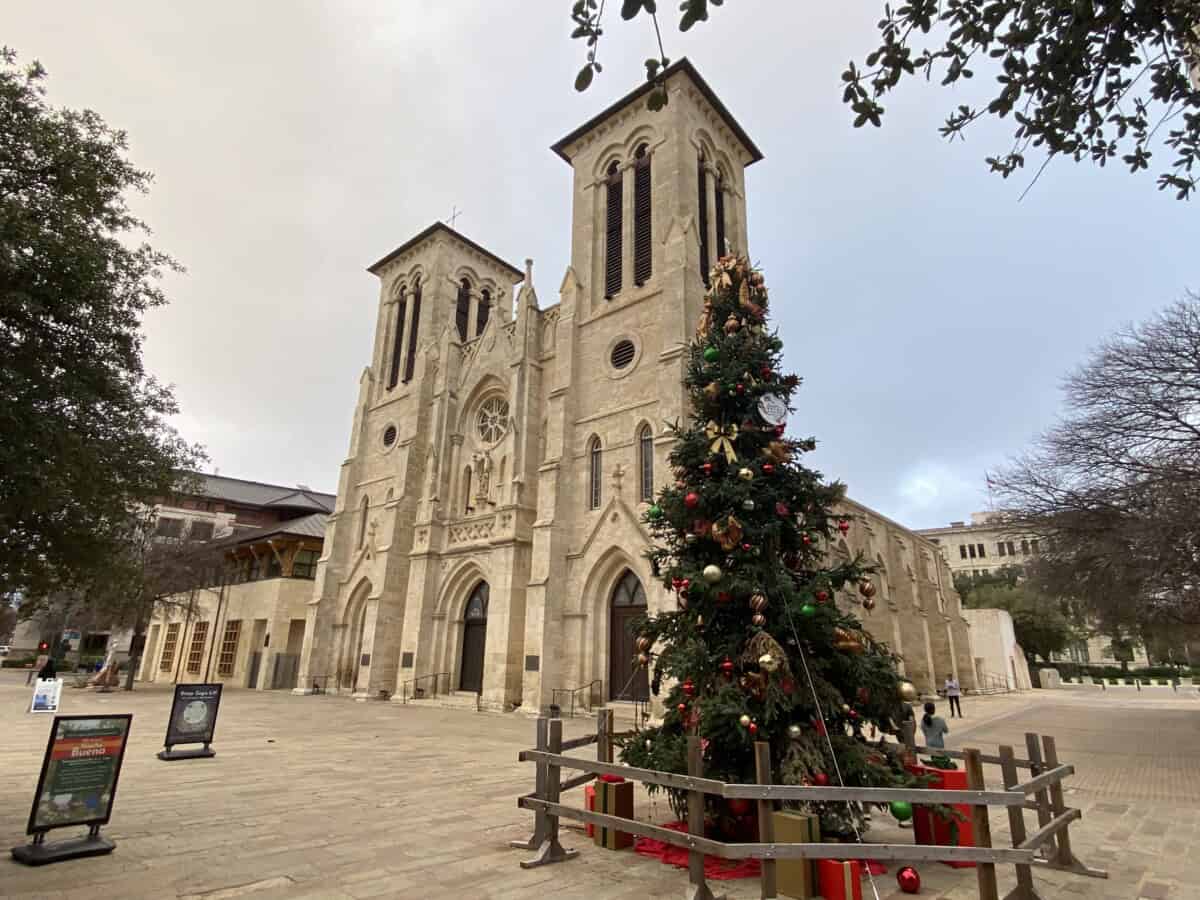
Across Dolorosa Street is San Fernando Cathedral (pictured at the top of this post), the oldest church in Texas. The congregation, comprised of families from the Canary Islands, began meeting on this site in 1731. The church has played a significant role in San Antonio’s history. Jim Bowie (of the Bowie knife and Alamo fame) married his wife here in 1831. In 1836, Mexican Leader Santa Anna used the church as a lookout during the Battle of the Alamo and hung up the red “No Quarter” flag. Many residents believe the bones of Bowie, Travis, and Crockett are buried here.

After Francis Girard renovated the church building in 1868, adding twin bell towers and triple portals, it became a cathedral in 1874. As we walked in, we saw the stone sarcophagus that supposedly holds the bones of the Alamo defenders. Stained-glass windows lined the cavernous space leading up to the golden retablo. I loved the hushed silence that greeted us the moment we walked in, the Nativity scene, and the colorful poinsettias.
Although we didn’t see it, the church hosts a free, nighttime light show called The Saga. The 25-minute presentation highlights San Antonio’s history on the facade of the cathedral.
Conclusion
San Antonio is a vibrant city celebrating its rich heritage. If you can only do one thing, visit the River Walk – it’s what makes San Antonio unique. You’ll also want to walk around the downtown area, exploring the Menger Hotel, the Medical Arts Building (now Emily Morgan Hotel), Spanish Governor’s Palace, and La Villita Historic Arts Villa.
The Alamo is another must-see destination in San Antonio. Entrance to the chapel and grounds is free. However, you will need to purchase tickets for guided tours, the Alamo Exhibit at the Ralston Family Collections Center, and Surrounded! The Augmented Alamo Experience in the low barracks. You can find more information here.
Stay tuned for the next post on our visit to Mission San Jose, part of San Antonio Missions National Historical Park!
Pingback: Mission San Jose - San Antonio, TX • Finding Family Adventures