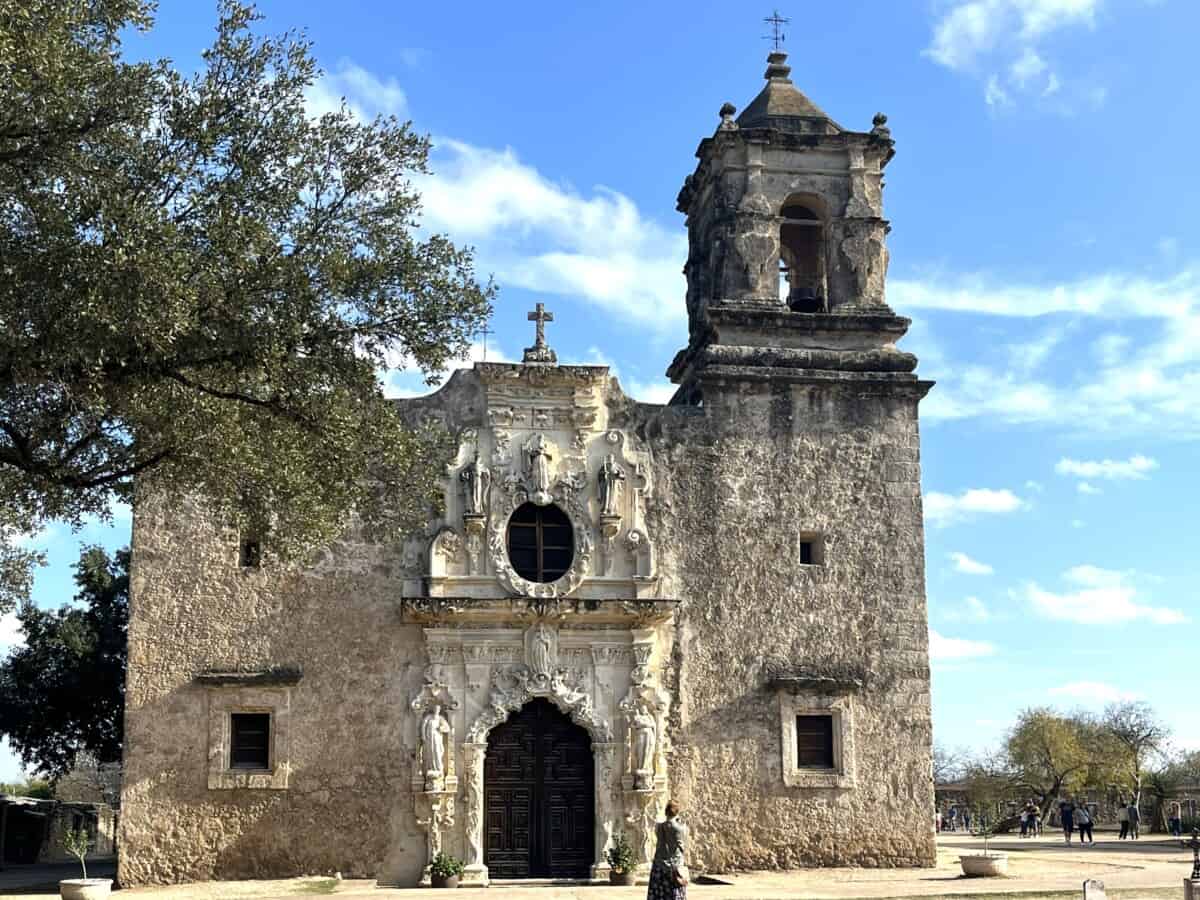
After spending most of our time in downtown San Antonio, we headed to Mission San Jose. Just five miles south of downtown, Mission San Jose, also known as “The Queen of the Missions,” offers a glimpse into Colonial Spanish life in the New World.
Until 1821, Texas was part of Mexico, which was really part of New Spain. The Spaniards built hundreds of missions across Mexico. In San Antonio alone, missionaries built the five missions along the San Antonio River in the 1700s. These missions were connected to each other by the King’s Highway (El Camino de Real de los Tejas), which stretched from Mexico City to the Sabine River at the Texas/Louisiana border.
Founding of Mission San Jose
The Franciscans founded Mission San Jose y San Miguel de Aguayo on the east side of the river in 1719. For unknown reasons, it moved to its present site on the other side of the river around 1727. By 1758, Mission San Jose housed over 280 Native Americans and included a granary, friary, church, mill, blacksmith shop, and soldiers’ quarters. Cattle totaled 1000, and sheep totaled over 3,200. It was a large operation!
Fast forward to 1941. After a restoration project by the Works Progress Administration (WPA), the National Park Service (NPS) designated Mission San Jose a National Historic Site, the first in Texas. You can see photos of the mission before the restoration here.
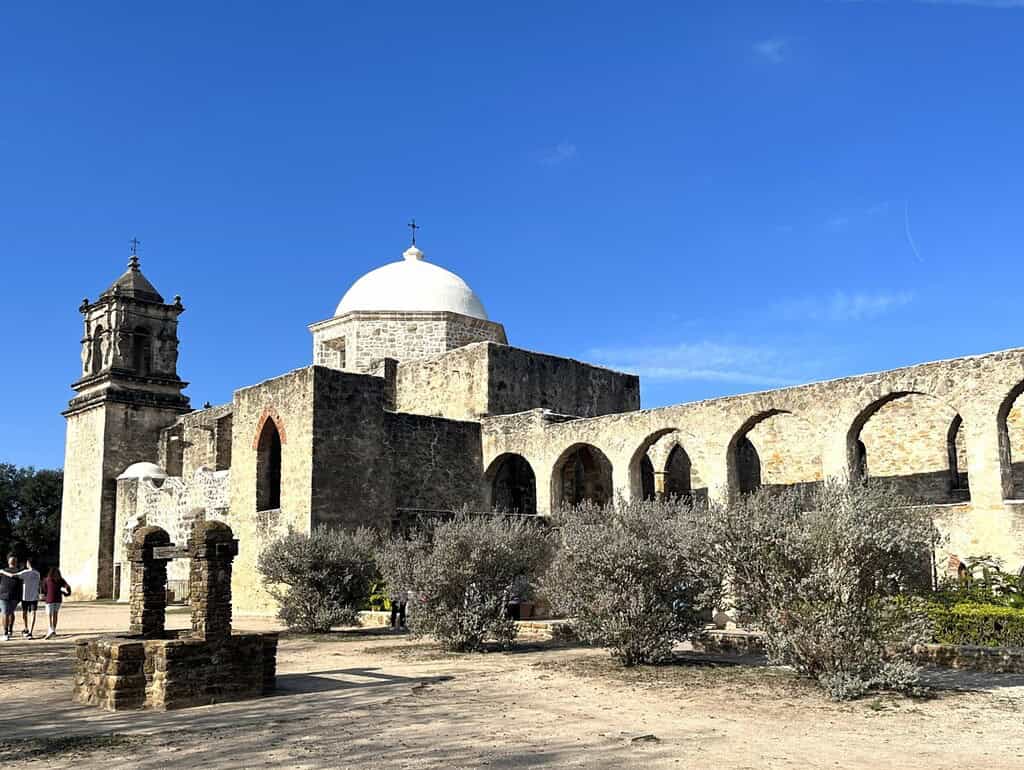
Although interest in preserving the other San Antonio missions grew, it wasn’t until 1978 that President Jimmy Carter created the San Antonio Missions National Historical Park. The new designation, at a cost of $40 million, incorporated Mission Concepcion, Mission San Juan Capistrano, Mission Espada, and Mission San Jose into one park.
It took another few years to work out the separation of church and state. In a joint partnership, the NPS agreed to maintain and preserve the sites, while the Archdiocese of San Antonio owns the mission churches and operates them as active parishes. In 2015, UNESCO designated the five missions (the Alamo and the four within Missions National Historical Park) a World Heritage Site, the only one in Texas.
Mission San Jose Grounds
Although DH (Dear Hubby) and I have been to all of the missions, we only visited Mission San Jose on this trip. We chose it because Mission San Jose is the largest of the San Antonio missions and offers the most complete view of how missions looked when first built.
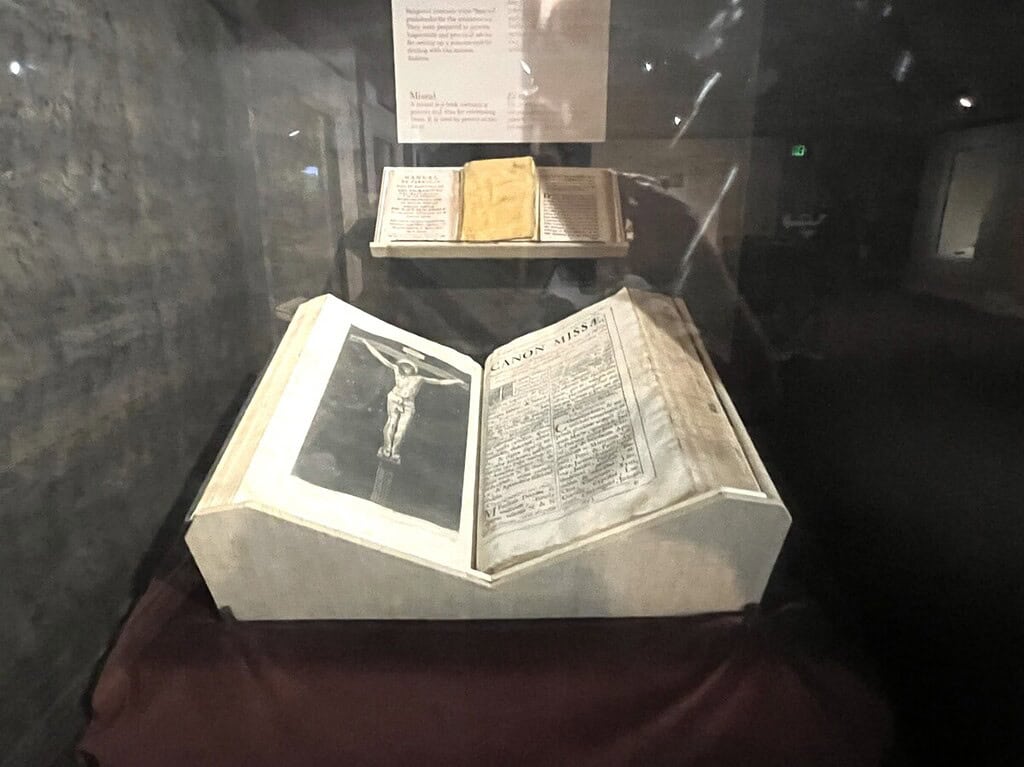
The visitor center showed a 25-minute film, “People of Reason,” at the top of the hour. After the video, we wandered around the museum exhibits, which gave a better overview of the mission. Many of the exhibits featured artifacts recovered from archaeological excavations on the site.
Now it was time to walk through the main entrance of Mission San Jose. The area inside the stone walls was vast! To the right, a long wall with open doors beckoned us to walk inside. Through a series of low-ceilinged rooms, we came to a rounded corner room with peepholes. This was one of two bastions where soldiers had a clear view of the main entrance.
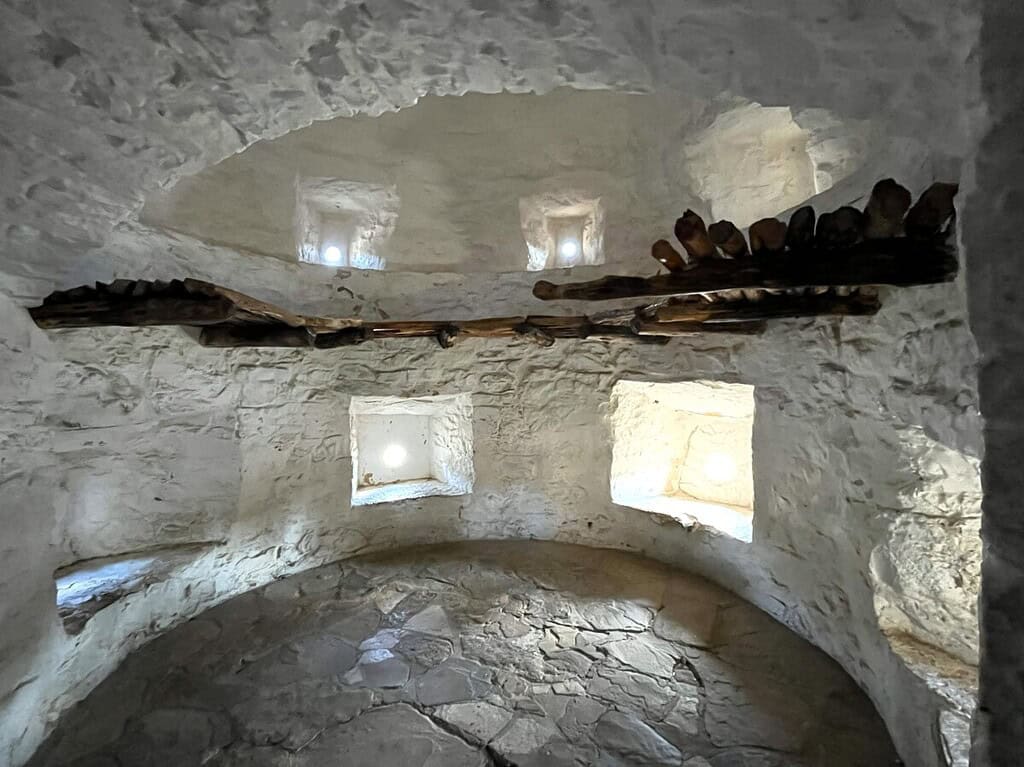
The primary goal of the mission was to teach Native Americans about Catholicism, the Spanish language, and farming techniques. Another function was to protect against Indian attacks. In 1868, the inhabitants constructed the stone walls on all four sides and built two bastions to protect the main entrance. Soldiers would staff the bastions and fire muskets from the rounded holes if an enemy attack occurred.
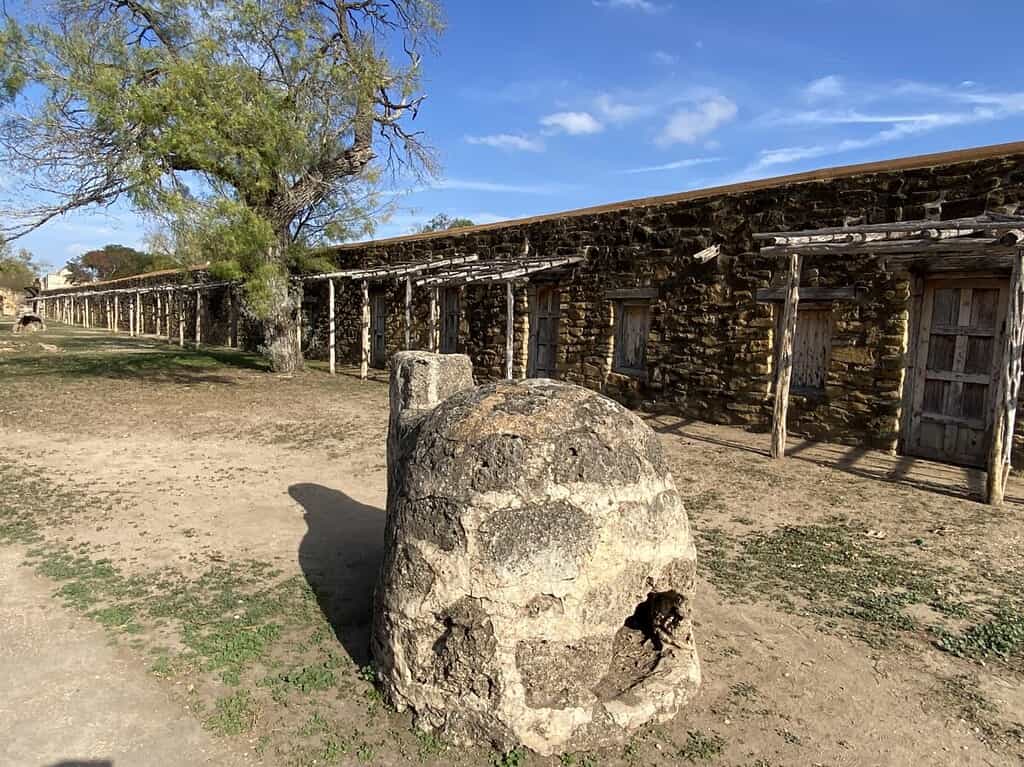
We then walked through the Indian Quarters. Each quarter included a small, two-room apartment consisting of a bedroom and a kitchen (basically a room with a fireplace). The doors led out onto the Main Plaza so the Indians couldn’t leave without permission. The sand-colored walls of this long building were originally made from tufa, a porous limestone. However, during the 1930s restoration, engineers substituted tufa for the much harder sandstone.
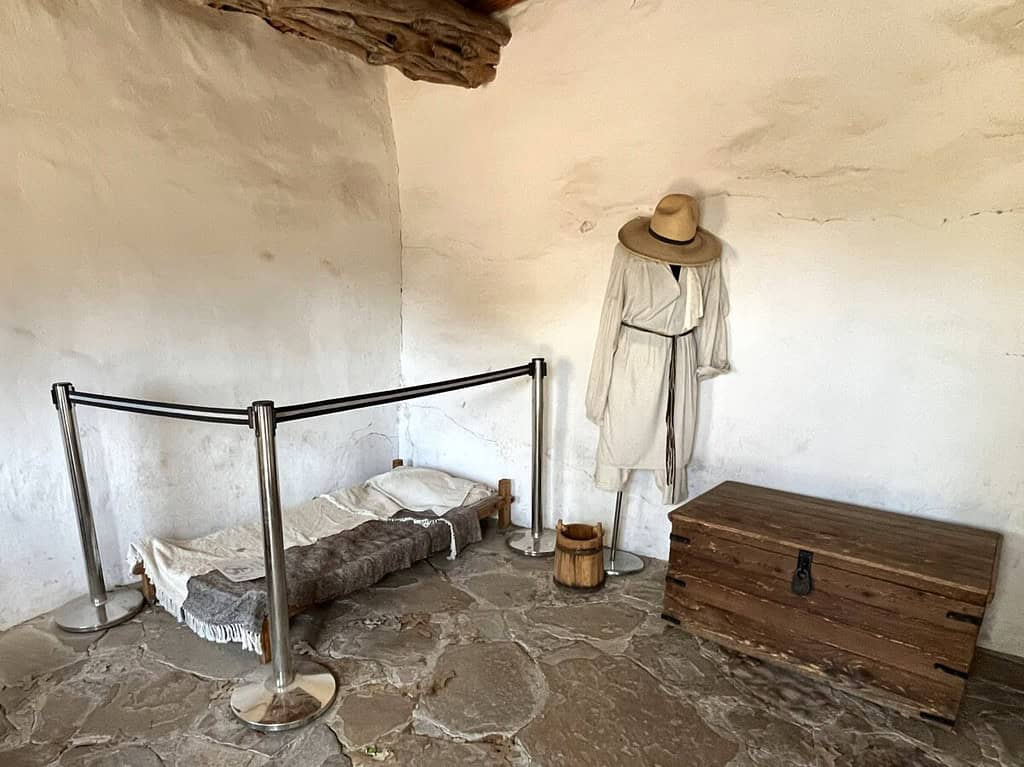
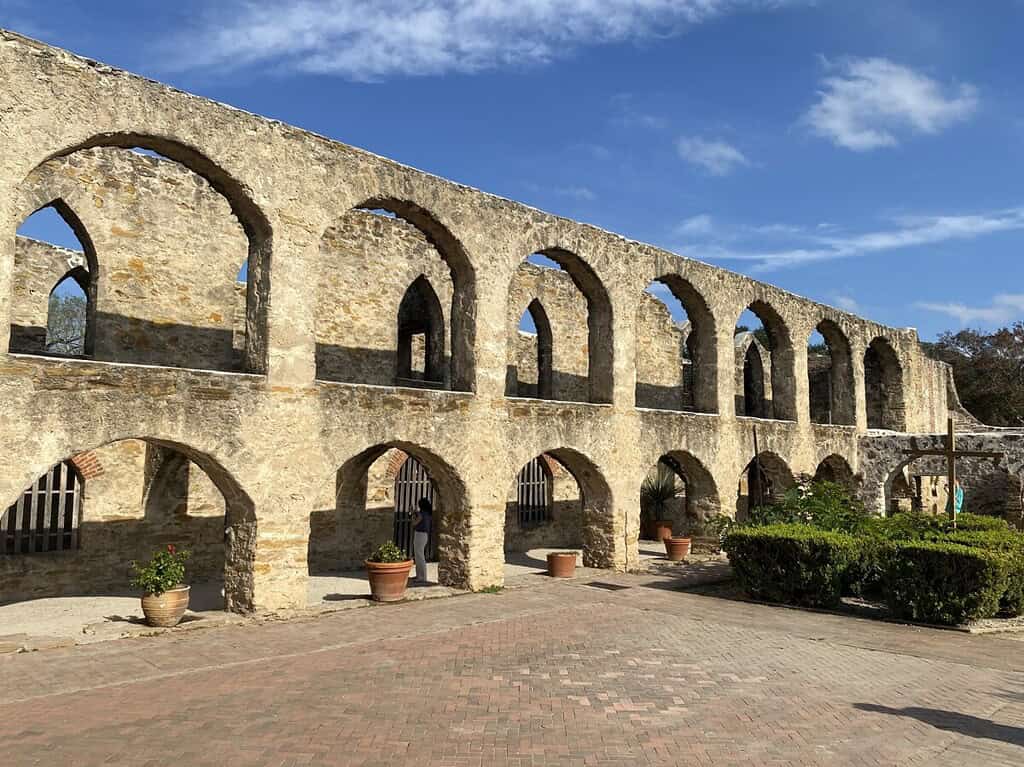
Before walking into the mission church, we passed the Convento where the missionaries lived. This area originally boasted nine rooms on the ground floor and five rooms on the second floor – much larger than the Indian Quarters.
San Jose Church
When the Franciscans established missions, they built rudimentary buildings until they had a larger workforce (Indigenous people) and better materials to build sturdier structures. Construction on the present church at Mission San Jose began in 1768 and took 14 years to complete.
When I think of Spanish-Colonial architecture, I think of beige and tan-colored structures. In fact, the missions were very colorful when first built. A section of the church’s exterior, shown in the photo, reveals multi-colored patterns, resembling tile, painted on the walls.
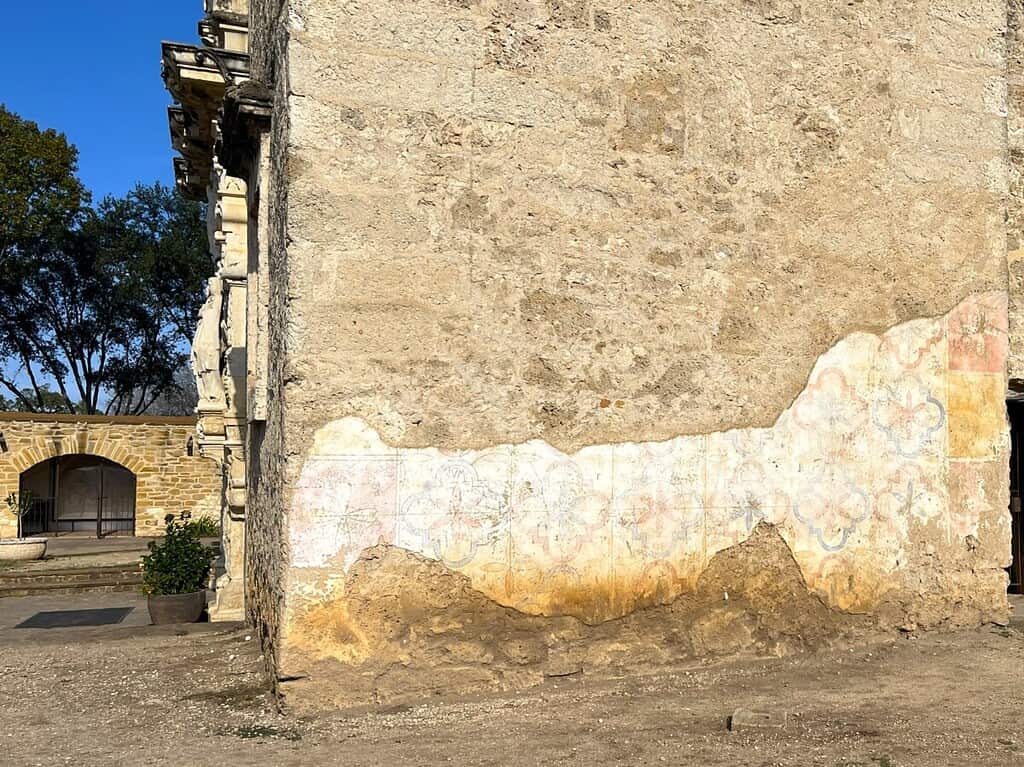
Preservationists discovered the murals (also called frescoes) contained four colors: yellow, red, black, and blue. Indigenous people used yellow and red pigments made from iron oxide found in clay. The black pigment came from carbon, while the blue pigment possibly came from imported cobalt.
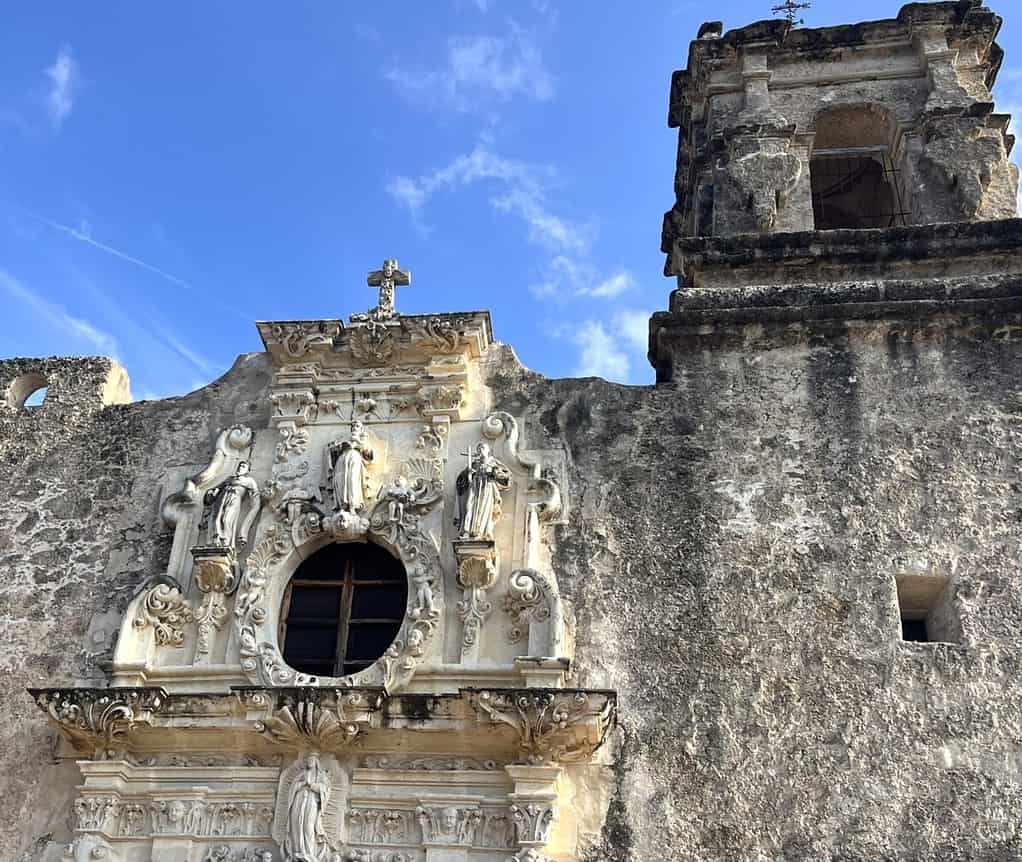
At the front of the church, we admired the detailed work in the façade. Shells, hearts, angels, and six saints were carved in limestone. No wonder Mission San Jose is called “Queen of the Missions!” Entering the grand, wooden arched doorway, we felt the hushed silence of the sanctuary.
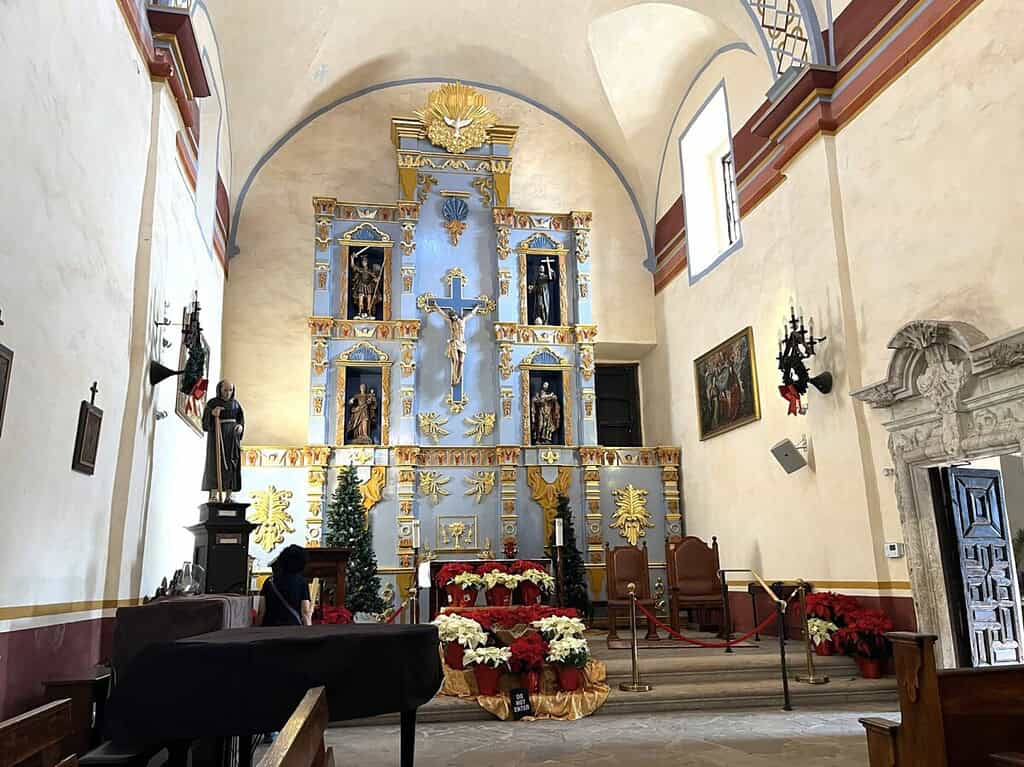
Inside the church, light entered through the four windows in the domed ceiling and four additional windows located high on the side walls. The Retablo featured pale blue walls accented by 24-karat gold paint. Four sculptures surround Christ on the Cross (clockwise from top left): St. Michael the Archangel, St. Francis of Assisi, Joseph, and the Virgin Mary. Historians believe the sculpture of St. Joseph is the oldest in the missions. The sanctuary underwent a $2.2 million renovation in 2011, funded by the Archdiocese of San Antonio.
Grist Mill, Granary, and Soldiers’ Quarters
Outside the mission church, we walked through an archway leading to the mission’s grist mill. Water from an irrigation canal filled the adjacent cistern, which powered the grinding stone. Incidentally, this is the first known grist mill in Texas.
A large model of Mission San Jose was on view in the Granary. This building would have held the grain necessary during cold weather. In the Main Plaza, we walked past two graves and multiple water wells.
Afterwards, we wandered through exhibits in what had been the Soldiers’ Quarters. These rooms detailed more of mission life. On one hand, the mission provided safety for its inhabitants. On the other hand, the Natives had to learn Spanish and Latin, adopt a different religion, and basically provide forced labor to keep the self-sustaining community thriving. Was it worth the trade-off?
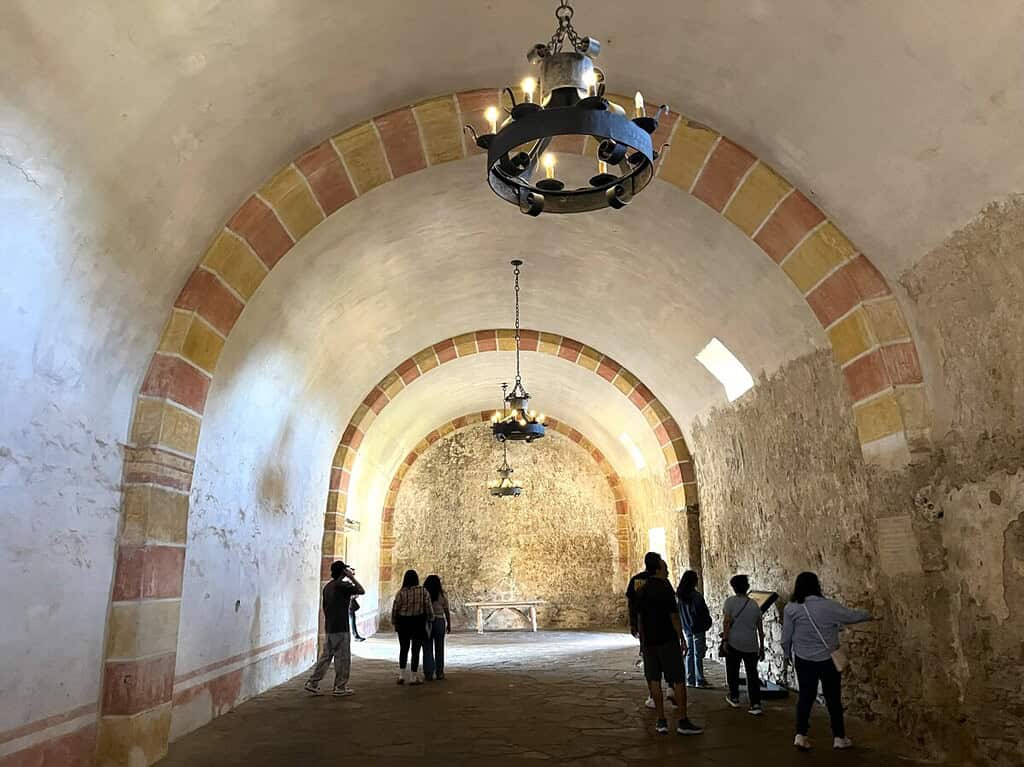
Mexico wondered the same thing. Due to the costs of constant upkeep, Mexico ordered partial secularization in 1794. The missionaries divided up the land, cattle, tools, and equipment among the 110 Native Americans living there. By 1815, the number of Natives at Mission San Jose decreased to 49. All the while, the missionaries stayed there. After complete secularization around 1824, Mission San Jose fell into disrepair.
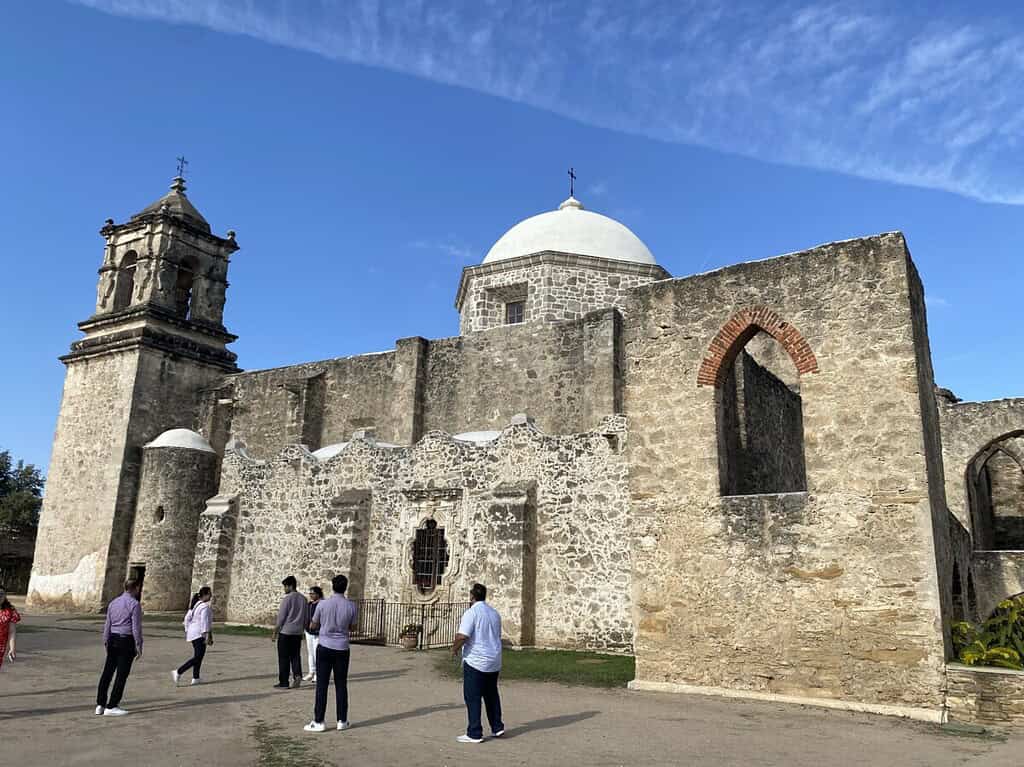
Benedictines from Pennsylvania reopened the mission church for services around 1858 for ten years. However, the North Wall collapsed in 1868, followed by the Dome in 1874. The Holy Cross Fathers and Brothers from Notre Dame intermittently held church services in the sacristy for another decade, but the mission buildings continued to decline.
Around 1925, the San Antonio Conservation Society formed and began purchasing land at Mission San Jose. When the Bell Tower partially collapsed in 1928, the organization and the Catholic church realized a full-scale restoration needed to begin soon. In 1932, the Society, with the Catholic Church, the WPA, and several other organizations, began rebuilding the Granary, Dome, Bell Tower, and other structures. From 1941 to 1978, the Texas Parks and Wildlife Department operated Mission San Jose and led archaeological studies.
Conclusion
The visit to Mission San Jose took about 90 minutes, including the movie. Admission to the park is free and you can easily visit all the missions since they are only about 2-3 miles from each other. For more information, visit the San Antonio Missions National Historical Park website here. Also, El Camino de San Antonio Missions offers pilgrimage tours.