
After flying into San Antonio on Christmas Day, we spent 24 hours touring the downtown area and Mission San Jose. Now it was time for our real vacation in the Texas Hill Country to begin!
Texas Hill Country
Located in Central Texas, the Texas Hill Country features gentle hills, winding roads, and tons of wineries. It’s totally different from the flat, congested city of Houston or even the tall pine trees and thick woods of East Texas.
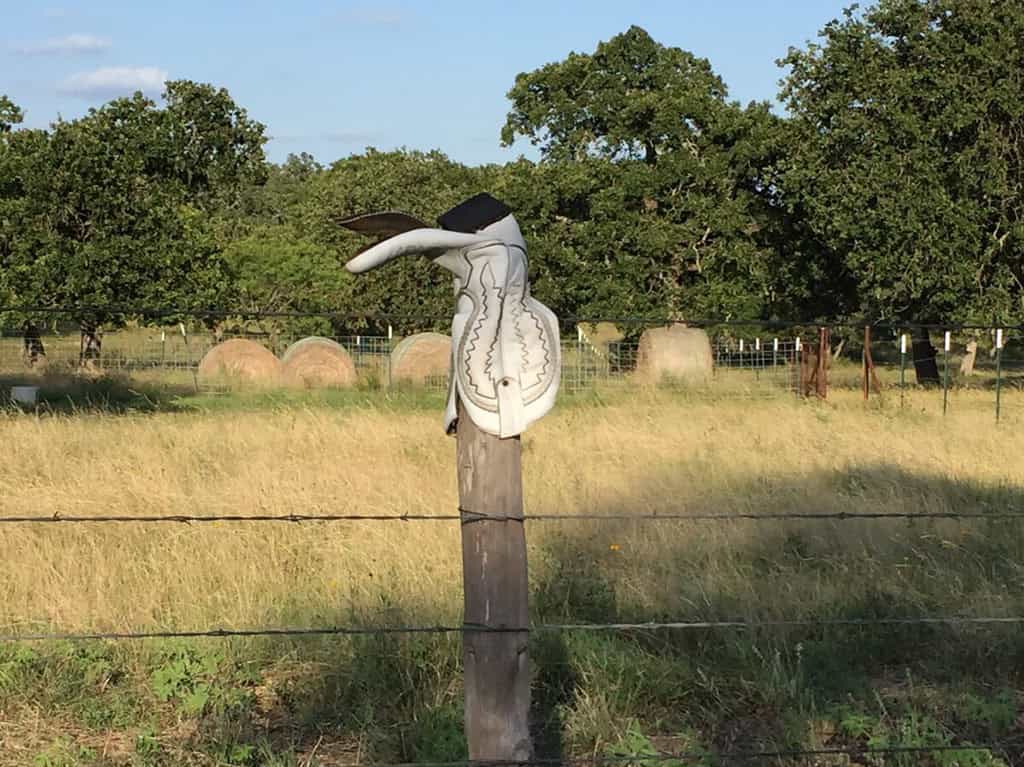
What struck me most about the Hill Country on our first visit was the breeze! Texas gets hot. There’s no two ways about it. But even amid 100-degree temperatures, the hill country breezes provide relief. Maybe that’s why LBJ often entertained at his ranch in Stonewall during his presidency.

The Hill Country consists of two dozen counties stretching west of Austin and north of San Antonio. Read any issue of Texas Monthly, and you’ll see stories about the charming hill country towns of Llano, Fredericksburg, Comfort, Marble Falls, Kerrville, Luckenbach, and more. Numerous rivers, such as the Guadalupe, Pedernales, and Frio, traverse the area, making it a popular spot for over 40 Texas summer camps.
Fredericksburg
Fredericksburg is a major town in the Texas Hill Country. Settled by Germans in 1846, the town (population 11,000) offers shops, restaurants, and the National Museum of the Pacific War along its Main Street. Our VRBO was just about 10 minutes north of town, so we had the best of both worlds – a rental overlooking peach orchards and stargazing, but convenient access to restaurants and grocery stores.
Fredericksburg’s Main Street resembles a combination of an old Western Town and a German Village. The architecture consists of many stone buildings and half-timbered structures, many of them original. Across from the Gillespie County Courthouse is the Marktplatz, a public park. In addition to pavilions and a farmers’ market, visitors can tour a replica of the Vereins Kirsch, an octagonal-shaped building used as a church and school in the 1800s.

Another historical building at the other end of Main Street is the wood-framed Nimitz Hotel. Charles H. Nimitz, a former German merchant marine, opened the hotel in 1860 with only four rooms. Subsequent expansions included its steamship facade, additional guest rooms, a saloon, ballroom, and a general store. Over 100 years later, the property became the Fleet Admiral Chester W. Nimitz Naval Museum, now part of the National Museum of the Pacific War.
National Museum of the Pacific War
Admiral Chester W. Nimitz, grandson of the hotel owner Charles H Nimitz, served as Commander-in-Chief of the Pacific Fleet during WWII. His main counterpart was the more attention-seeking General Douglas MacArthur, who commanded the land forces. In 1967, the town created the museum to honor Nimitz. With the addition of the Japanese Garden of Peace in 1976 and the George H.W. Bush Gallery in 1991, the museum changed its name (and focus) to the National Museum of the Pacific War in 2000.
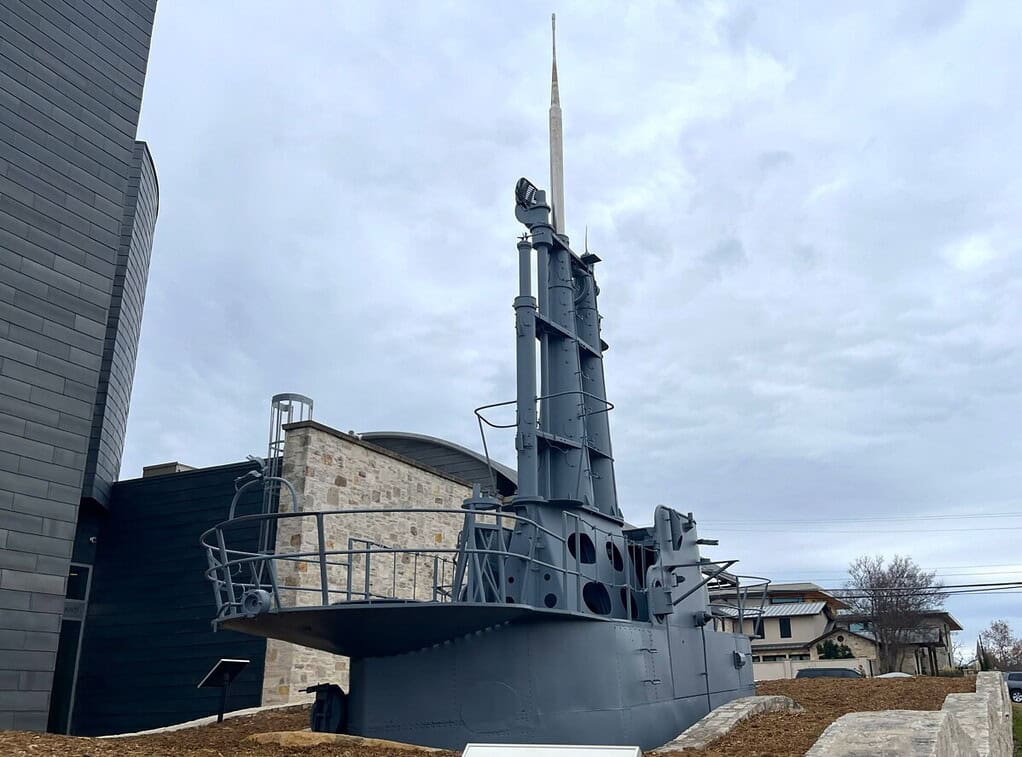
We purchased tickets and entered the 6-acre museum campus, which comprises three buildings: the Nimitz Gallery (inside the old hotel), the Bush Gallery (next door), and the Pacific Combat Zone (a few blocks away).
Nimitz Gallery
Inside the Nimitz Gallery, we learned more about the hotel and the Nimitz family. Chester Nimitz’s father died before he was born, so his grandfather, Charles, became the most influential figure in his life. Raised in nearby Kerrville, Nimitz initially sought a slot at West Point Academy. Instead, he gained acceptance to Annapolis at age 16.

Exhibits highlighted his leadership style, service during WWI, appointment by FDR as Commander in Chief of the Pacific during WWII, and his dislike of MacArthur. We also learned about his post-war years and retirement. In fact, he only agreed to the museum as long as it “honored all the everyday people who served with him.”
George H. W. Bush Gallery
Between the Nimitz and Bush Galleries, we briefly walked past the Pearl Harbor Memorial Wall, Memorial Courtyard, and Plaza of the Presidents. We completely skipped the Japanese Garden of Peace because it was 30 degrees outside.
The Bush Gallery just reopened after a major renovation to its over 20,000 square foot building. It chronicles every Pacific battle during WWII, starting with Pearl Harbor. On display was the HA-19, a miniature Japanese submarine that was used in the attack. All in all, eight US battleships were damaged, but only the USS Arizona and the USS Oklahoma were completely destroyed.
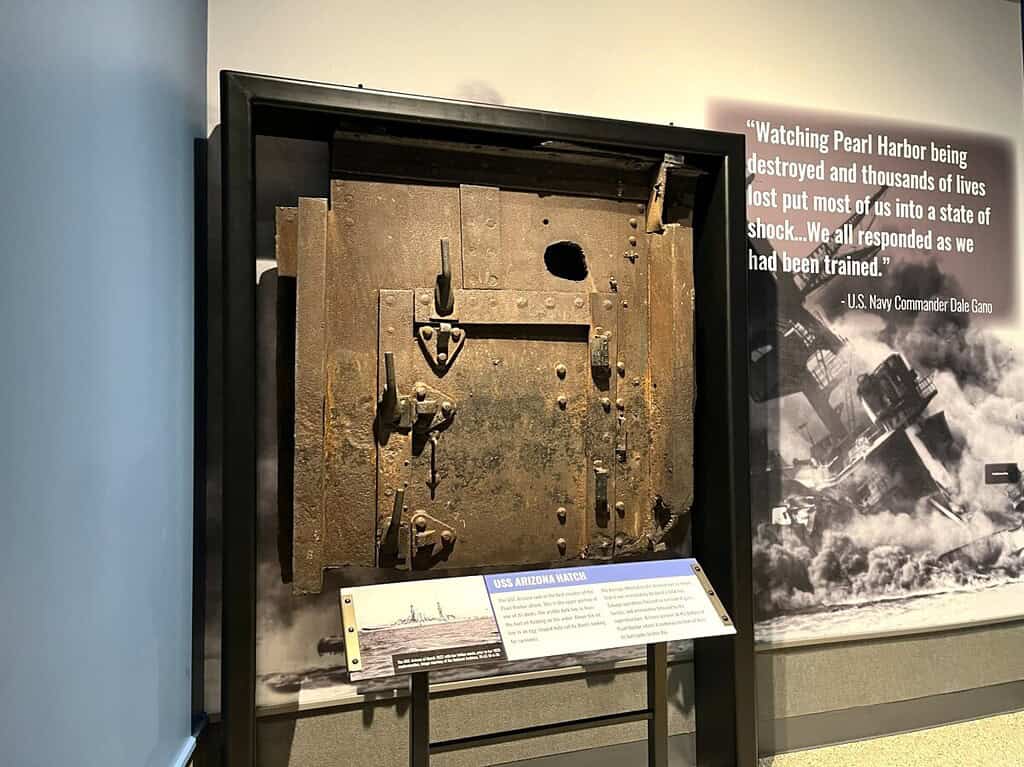
Until this museum, I didn’t realize the Japanese invaded and occupied Guam, the Philippines, and Wake Island right on the heels of Pearl Harbor. Films and artifacts walked us through the Doolittle Raid, Midway, New Guinea, Leyte, and more.
One thing I liked was that in certain exhibits, a video played as if someone serving in the conflict were talking directly to you. It, plus the palm trees in the gallery, made the experience more vivid. At the end of the first hand account, the screen displayed detailed information about the actual person.

The museum explains the US strategy of island-hopping. Instead of going after islands with large Japanese strongholds, the US leapfrogged to lesser-fortified islands to gain a foothold in the Pacific. I had heard of the Solomon Islands, but not the Gilbert Islands, Tarawa, or Peleliu, one of the bloodiest battles in the Pacific. The Flying Tigers and their efforts in Burma are highlighted, as well as the five Sullivan brothers, killed on the USS Juneau.

The exhibits build up to the development of the atomic bomb and the resulting Allied victory. For an extra fee, visitors can experience “The Rescue,” an immersive exhibit set in the 1944 Philippine Islands. Since it was now closing time, I didn’t have a chance to explore it or tour the Pacific Combat Zone.
Johnson City – The Twinkliest Town in Texas
On another night, we drove to Johnson City (pop 1,100) to see the Christmas lights. Known as the “Twinkliest Town in Texas,” Johnson City boasts over 2 million lights in the historic square. While the lights were festive, it wasn’t until we walked over to the Pedernales Electric Co-op (PEC) headquarters that the lights really awed us. They were wrapped all over the trees in blue and gold.

With all these twinkly lights, it’s hard to believe the area didn’t have electricity until 1938. That came about when LBJ, who grew up here, became a freshman congressman. He helped farmers navigate the red tape and density requirements to create PEC, one of the largest co-ops in the country. Fittingly, the headquarters sits across the street from the LBJ Boyhood Home.
Conclusion
The National Museum of the Pacific War is a wonderful place to visit, but plan to spend at least 2-3 hours. The museum allows you to leave and come back if you want to take a break or find a place to eat in downtown Fredericksburg. For more information about the museum, click here.
Another must-do activity is Enchanted Rock. The 1.6-mile (round-trip) Summit Trail offers views of the Hill Country landscape. We did this trail on our first visit several years ago. However, the state park now requires trail reservations on weekends, school breaks, and holidays. By the time we realized this, all slots were filled.

I also recommend the LBJ National Historical Park in Stonewall. The Texas White House Complex, also known as the LBJ Ranch, features Air Force One, tours of the main house, the reconstructed LBJ birthplace, the show barn, the cemetery, and more. While the main house and hangar are currently closed for renovations, you can drive through the ranch. We toured the main house years ago, and it was fabulous. The Johnson City part of the historical park includes the LBJ Boyhood Home. I think the LBJ National Historical Park is better than the LBJ Presidential Library and Museum in Austin.

You can also check the Fredericksburg Convention and Visitors Bureau for a complete listing of restaurants and wineries. Enjoy your visit to the Texas Hill Country!