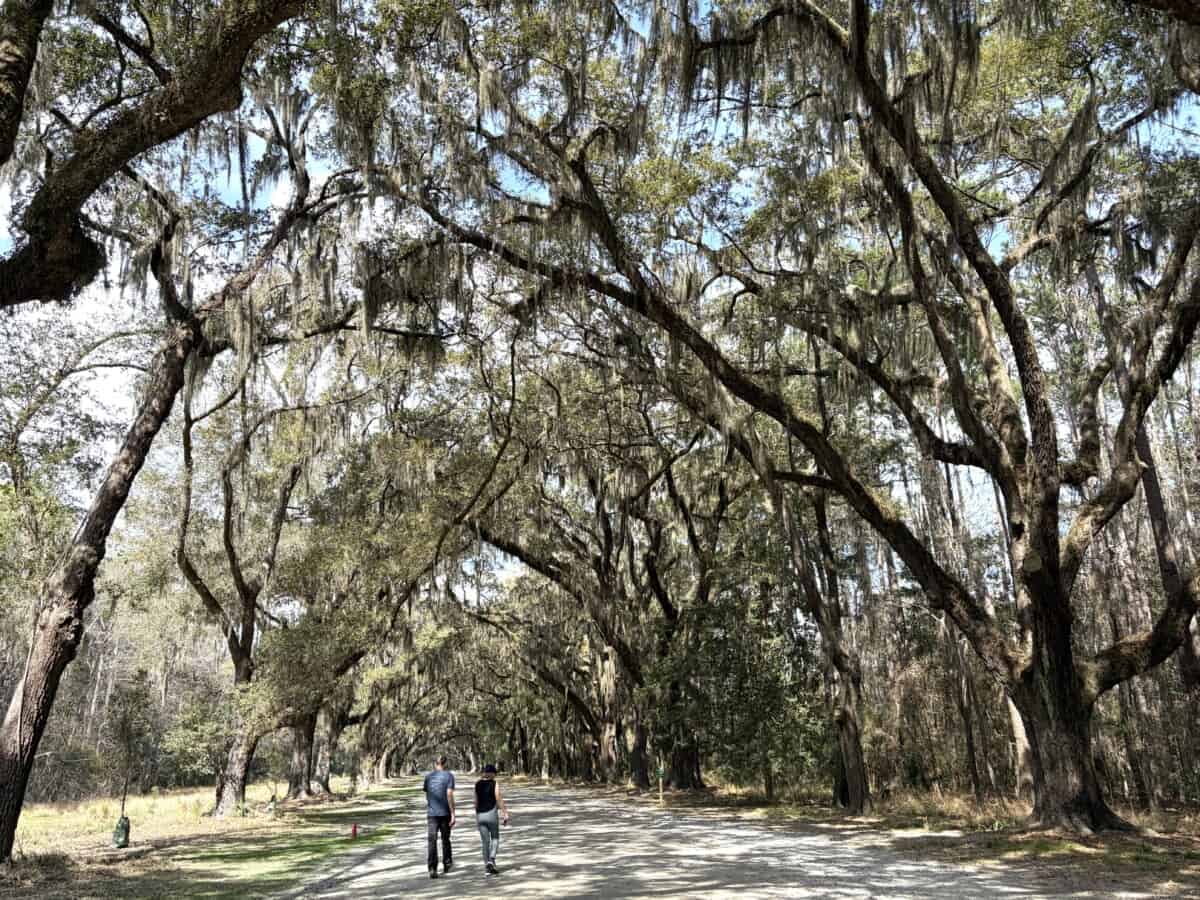
Before heading back to Atlanta from our Coastal Georgia getaway, we had one more site to visit – Wormsloe State Historic Site. The 822-acre site sits on the Isle of Hope, less than 10 miles south of Savannah.
While in the area, we also made a brief stop at Skidaway Island State Park. Unfortunately, a rain shower put a damper (literally) on our visit, so we had to discontinue our hike. However, I’ll talk about it here, too.
First, we stopped for lunch at Clary’s Cafe. The establishment began in 1903 as a pharmacy but soon became a lunch counter and ice cream parlor. I first read about it in John Berendt’s bestseller, “Midnight in the Garden of Good and Evil.”


The all-day breakfast spot became even more famous after the book and subsequent movie. Yet, despite its popularity, Clary’s still remains a hole-in-the-wall with good food. We were lucky enough to get one of the last outside tables facing the beautiful (and posh) E. Jones Street.
Wormsloe State Historic Site
We left historic Savannah and headed south for about 25 minutes before passing the famous Wormsloe front gates. Just a bit further, we turned into the new entrance leading to the recently built 6,000-square-foot visitor center.

I liked how the visitor center faces away from the parking lot. Guests walk through a large open porch area with rocking chairs situated in front of a massive brick fireplace. It turns out the ironwork above the hearth came from the original property.
Trolley
To protect the historic trees, the park no longer allows cars to drive along the avenues of oaks. Instead, visitors can walk, ride bicycles, or take the free, narrated open-air trolley every 30 minutes from the visitor center.
On the trolley ride, the Georgia State Park Ranger told us about Wormsloe’s history. But first we had to make a quick stop. A small dog, riding in the lap of her owner, got spooked and jumped off of the trolley while we were in motion!

About this time, we made the turn onto Oak Avenue. Over 400 live oaks draped with Spanish moss flank both sides of this 1.5-mile dirt path, pictured in the cover photo of this post. These were planted by fifth-generation owner Wymberly Jones De Renne upon the birth of his son, Wymberly Wormsloe De Renne, in 1891.
He also commissioned the formal entrance arch above the front gates. The dates 1736 (the year Jones founded the plantation) and 1913 (the year De Renne erected the arch) are inscribed next to Wormsloe. Just imagine being a visitor and coming through these gates in a carriage back in the day!
Now for the history of this former plantation. Noble Jones, a young carpenter from England, was one of 120 passengers who sailed with James Oglethorpe aboard the Anne to Savannah in 1733. He leased 500 acres from the Georgia Trustees in 1736 and named it Wormslow (notice the original spelling) after his family’s hometown in Herefordshire. Jones officially owned the land by 1756 and grew rice, indigo, cotton, mulberry trees, and grains. Upon his death in 1775, his will stipulated that Wormsloe stay in the family forever.

The descendants didn’t have much interest in Wormslow until Noble Jones’ grandson George Jones built a two-story house on the estate. His son, George Frederick Tilghman Jones (1827-1880), purchased an additional 250 acres, added a third floor to the house, changed the spelling of the estate to Wormsloe, and, in 1866, officially changed his name to George Wymberly Jones De Renne. Known for philanthropic pursuits such as the Georgia Historical Society, De Renne cultivated Sea Island cotton on the land and amassed a large literary collection. When he died, his estimated fortune totaled $58 million in today’s money.
De Renne’s grandson, Wymberley Wormsloe De Renne (1891-1966), opened his extensive gardens to the public in the 1920’s. When he and his wife moved to Athens after selling the entire library and papers to the University of Georgia, the estate went to his sister Elfrida De Renne Barrow.
About this time, we passed Wormsloe House, but we couldn’t see it through the oak trees. This is the home where family members live today. The area is private and not part of the state property. After Elfrida De Renne Barrow died, her son transferred the property, except for Wormsloe House and the 50 acres surrounding it, to the state in 1972.
Wormsloe Museum
Soon, the trolley stopped at the museum, which used to be the old visitor center. Inside, we walked past exhibits on early Georgia history and learned more Noble Jones.


Jones built a reinforced tabby house in 1745. Because the area was at risk of being targeted by Spaniards, Jones also constructed a wooden fort-like structure about a mile away on Pigeon Island. He supplied his group of marines with weapons and two scout boats to protect the waterways leading to Savannah.
Ruins of Noble Jones’ Tabby House
A trail led a short distance to the Tabby ruins of Noble Jones’ house. Tabby, which consists of lime, oyster shells, and sand, was a cheap alternative to brick. The five-room house only measured 24 x 34 feet and sat in a courtyard surrounded by 8-foot walls. Family members abandoned the house sometime after 1805.

We walked along the marshy area looking across Jones Narrows. Visitors can also take an interpretive loop to see the Colonial Life area or the Battery Trail, which leads to the 20-foot-high Confederate earthworks built in 1861 at Fort Wimberly.

Instead of taking the trolley back, we decided to walk along Oak Avenue. Bicycles can also be rented at the visitor center. You can ride them along Oak Avenue, but not the trails behind the museum.
Wormsloe is important because it is one of the oldest coastal estates in Georgia and has been in the same family for almost 400 years. Plan to spend a couple of hours here.
Skidaway Island State Park
I’ve always heard of Skidaway Island. This unincorporated area of Chatham County encompasses The Landings, one of the largest residential golf neighborhoods, the UGA Skidaway Institute of Oceanography, and a 500-acre state park. Since Wormsloe is just about 7 miles from Skidaway Island State Park, we decided to pay a quick visit.

Arriving at the visitor center, we saw people checking into the campsites and yurts. Since rain was coming, we asked the park ranger about the quickest trail. She suggested the Sandpiper Nature Trail, located right behind the building.

The one-mile trail features a long boardwalk over salt flats. About this time, we heard thunder rumble, but soldiered on. As the boardwalk ended, lush green plants surrounded us on the trail — and rain began to fall. We turned around but realized this wasn’t a drizzle; it was a rainstorm. We ran back over the boardwalk, past the playground and palm trees, to the visitor center.
There’s so much more to see at Skidaway Island, and it’s worth a visit if you’re in the area. While we were drying off in the visitor center, we saw a full-size replica of a 20-foot sloth. The original fossil is housed in the Smithsonian, but was found on the island in 1823!
Conclusion
In my numerous trips to Savannah, I’d never seen Wormsloe or Skidaway Island. I’m so glad we made these stops, as the area boasts scenic oak trees, Spanish Moss, rivers, and a low-country vibe. This is where Savannah’s residents “summered,” and I can easily see why.
Wormsloe State Historic Site charges $12 per person (ages 12 to 62) to tour the grounds. You can click here for hours, bike rentals, and more information. Skidaway Island State Park charges a $10 per-car parking fee. Click here to learn about Skidaway’s trails, hours, and camping.

When you visit a Georgia State Park, you purchase a daily parking pass for $10. That parking pass stays in your car and would be honored at any other state parks you visit that same day. However, Wormsloe is a state historic site, not a state park, so you have to pay separate fees to visit both Wormsloe and Skidaway Island State Park. Even annual passes differ between state parks ($70) and historic sites ($50).
Since we knew our trip would include visits to several state parks and state historic sites, we checked out both annual passes from the Atlanta-Fulton County library system. The passes can be checked out for one week at a time every six months. If you live in Georgia, check to see if these passes are available at your local library.